Category Archives: Presentation Skills

As expected, iWork was beefed up for the new iPad, bringing Keynote closer to parity with its desktop older sibling. But don’t fret, Keynote users: I think we saw some hints of new features of the next Keynote for the Mac.

So the new iPad has been released (I ordered two of the top models), along with an updated AppleTV to take advantage of its retina display.

I will not at all be surprised when the tech pundits today boohoo the new iPad, from its failure to cure cancer through to its ungainly name, which I predicted would be the case in a previous blog entry, just because Apple can. And indeed likely enjoys playing the punditry for fools, while it laughs all the way to the bank.

Before I get to the main points of this blog entry, a couple of non-appearances are worth noting.

1. Where was Scott Forstall? I can’t recall an Apple keynote where the iPad and iOS were featured and he was not given a place on stage. Given he reports direct to Tim Cook, was this Tim’s way of further asserting his new CEO status? Or hopefully, a much more simple explanation.

2. Where was the much anticipated Microsoft Office for iPad which had the tech punditry all atwitter in recent weeks, once today’s keynote invitations had been sent out?

Instead, what we did see but not demonstrated were beefed up iWork apps, which like iPhoto for the iPad allowed Phil Schiller to drive home the message that “don’t let anyone tell you you can’t create on an iPad”. (You can see him refer to this at 1h:15m:20s, after you download the keynote podcast from the iTunes store ).

Indeed, Schiller emphasised the parity that now exists between iPad and Mac OS X devices like the iMac and Macbook since the Apple creative applications – iLife and iWork – now exist on both platforms with an extremely similar feature set.

I downloaded the Keynote update, now in V1.6, with the most important and obvious additions being  the near match between builds and transitions. It’s not quite 100%, and of course the iPad font set is still limited, so error messages may crop up after importing  desktop Keynote file with esoteric fonts.

In a previous blog post I had predicted that an updated desktop Keynote would not be released into the wild until there was much greater feature parity between the two versions, and this would require an improved iPad with respect to CPU and graphics. The hint Apple gave us that this was on the cards can be seen with the placement of the Keynote app icon in the tray for the keynote invitation illustration. I don’t know anyone who leaves Keynote there, myself included.

Which leaves desktop Keynote users to ask: : “Whither Keynote? You’ve not been updated for more than three years, so what gives?”

Clearly, much of the iWork team’s efforts have been directed to the iPad versions plus iBooksAuthor which also received an update today (V1.1) to account for the new iPad’s retina display.

There are clues however, and in today’s keynote I believe we saw hints that a new version – or at least some feature additions to the current version – are present.

Let’s go to the video replay…

In recent keynotes, Apple has been overenthusiastic about its use of the Anvil build, something which was last added to Keynote in a point update, as well as some new text builds. It’s been used when keynote speakers wanted to drop a bomb on us, so as to demonstrate “incredible” numbers of apps sold, or stores opened, or some other fact where expectations were crushed.

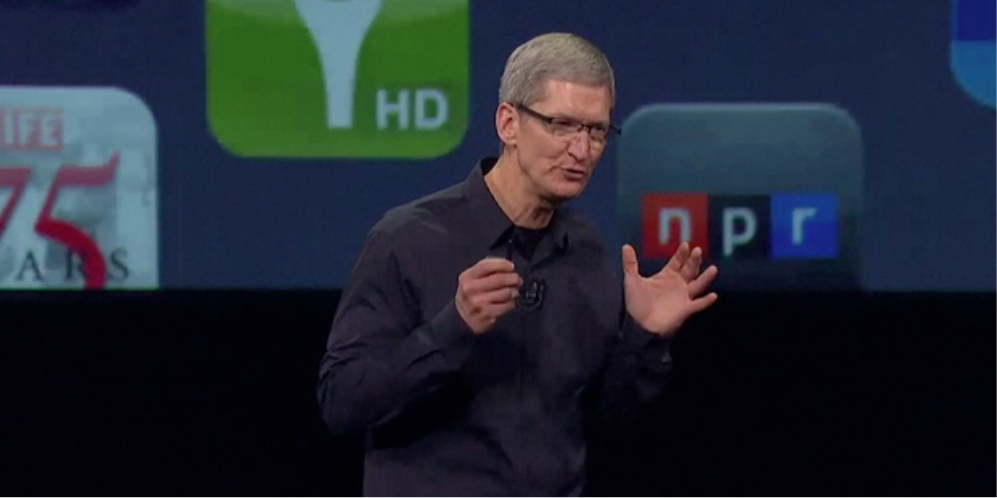
In the March 7 keynote, we didn’t see it at all. Perhaps it was a favourite of Steve Jobs, and here is Tim Cook asserting his status once more. If there was one build we saw quite often in today’s keynote, it was a variation of the “move” build, but this time two elements came in almost simultaneously, while pushing other elements no longer up for discussion, out.

If you have the podcast, go to 20m:14s, and here are some screenshots of what I noticed:

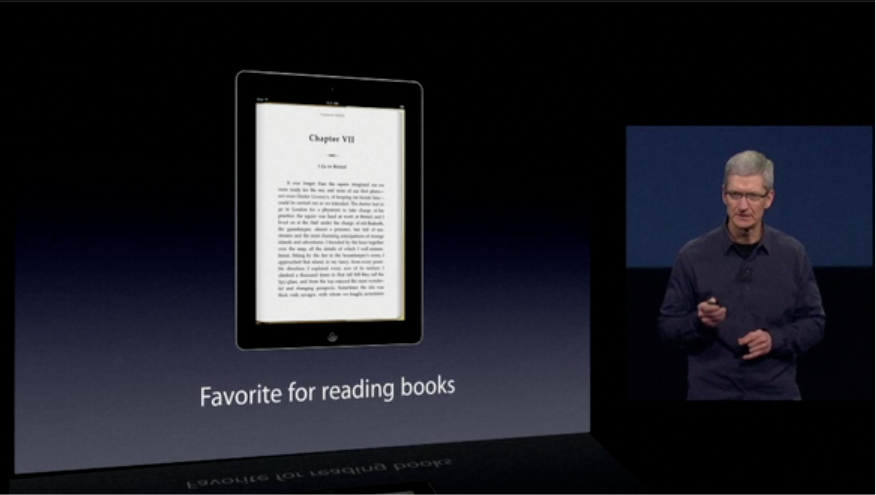
Here Tim is discussing how iPad users rate the device for various activities, such as reading books. He’s now going to discuss it as a favourite for playing games, so in the next click of his remote, the iPad image and text slide to the left, but not quite synchronously:


And now the new image and text slides in from the right, the text in the lead before the previous image has left the building:

And the rest now slides into place, the text once more leading the way:

And now the image aligns centred above the text:

Now, each of these could be performed with “move” builds – in and out – but some of these slides would require four of these, two each for text in and out, and two each of image in and out.

Because this effect was used several times in the keynote, I’m going to assert that it represents a new transition, similar to Magic Move, where you create each slide with its picture and text, and the transition does the work for you, such that you can control the delay and speed. Who wants to guess what Apple calls this new transition?

I suspect, however, this is was not the only transition. For some time now, I’ve been watching my AppleTV when it goes into screensaver mode. As with iPhoto, there are several very interesting ways that new photos can be brought in, including Origami. If you have an AppleTV, check in Settings for your screensaver options:

(Brian Burgess, at Groovypost.com has a nice set of screenshots and elaboration upon AppleTV screen saver options here).

When I noticed these in action, it caused me to wonder how nice they would be as additions to the Keynote transition set, especially as more people are using full size pictures, as well as multiple illustrations in Keynote.

I think I saw one new addition in the March 7 keynote, at 18m:22s:

It starts at the time Tim Cook has said Apple sold more iPads in the last quarter of 2011 than any PC maker sold all their PC products, and says iPads are “showing up everywhere in the daily lives of people”:

"It's showing up everywhere in people's lives"

What looks like an regular flip build out commences...

.. and we see the image on the flip side now...

Now more fully formed, but only occupying a section of the previous image's space, because...

.. a moment later it's joined by a second flipping image...

... which remains for a moment while the first flipped image now builds out with a flip...

... and now the second image begins its flip out...

... and now both images are replaced by four smaller images flipping in...

... and here is the final montage, this whole sequences taking about four seconds...

Now it’s quite possible to do all this with the current Keynote, but why would you? It’s not Apple’s way to make itself, and the user, work so hard, when it can create transitions to do it for you, with you merely selecting the images (or presumably, text).

I suspect there is one more new build or transition but the camera work was too poor to pick it up. It occurs about 20m:40s and here is the images I can grab but they are certainly uninformative:

Icons of the thousands of apps start popping in...

I suspect this popping of apps as a build in was in fact similar to what was shown at the Education keynote to introduce iBooksAuthor January 19th, and used the Object Zoom transition.

It’s a very underutilised effect, bit I did manage to use it myself at Macworld in January. See below.

If you think you saw some new Keynote effects, please add your thoughts in the comments section below.

Hey, Apple: If you can stream Paul McCartney over iTunes Live on my AppleTV, when you can start streaming your keynotes live (like the one in a few hours)? Especially if you release an upgraded AppleTV – heck, I’d even pay a few dollars from my iTunes account and get up at 5AM rather than wait for the delayed replay

If Microsoft Office comes to the iPad, it will be the best of times and the worst of times.

It was but a mere coincidence that after my previous blog article here, entitled,

“If the expression “Give me the child aged seven….” applies to the iPad and Keynote, I’d start to worry if I ran the Microsoft Office marketing department: Lessons from a Las Vegas school”

the blogosphere somewhat choked with the “news” reported by The Daily that they had seen Office ported to the iPad. From there, many sites echoed the report, some saying The Daily had been duped, others pursuing Microsoft for comment only to receive a strange kind of denial, that more would be known in a few weeks.

That didn’t help the rumour mongering, because the time schedule placed it into iPad 3 release rumour territory. “What is possible”, some asked, “that Microsoft would appear at the iPad 3 keynote to demonstrate Office for the iPad?”

And what would they mean for Apple, for Microsoft, for Google Docs, for Android devices, and for humanity in general? OK, it’s not that big a deal, but for many it’s a serious business. After all, Office is responsible for much of those billions Microsoft earns each month, it is the default communication platform in the enterprise and many academic and military settings, and its placement on the iPad is certainly worth contemplating for its meaning.

If memory serves me correctly, the last time Microsoft took to the stage with Apple in the form of Steve Jobs — happy birthday, Steve 😦 — it was in the form of Roz Ho, from the MacBU showing a version of Office for the Mac.

These were never really stellar performances, and Office for the Mac was always a step behind the capabilities of its Windows brother. So those of us with long memories will greet any availability of an Office app with a yawn, as long as we are already using iWork equivalents, such as Pages, Keynote and Numbers.

There is one Microsoft Office product in the App store, and that is OneNote. There are other MS apps of course:

Do note, if you’ll pardon the pun, that OneNote is free, but limited to 500 entries. After that, to add more you must upgrade for unlimited notes by an in-app purchase of $14.99. This may hint at the cost of individual Office apps or we may see a bundled suite.

How Microsoft chooses to price and assemble Office will intrigue some for the next few weeks, given Apple showed its hand at the very beginning of the iPad Journey almost two years ago (less a few days).

The reviews for OneNote are not great in general, and indeed it’s competing against many very fine and not very expensive notetaking apps, including the free Evernote, as well as Notify.

It was the best of opportunities

For Microsoft, it must have come as an inevitable acknowledgement of the iPad’s market power to bring Office to it, while still developing its own tablet software with a full Windows 7 installation and a version of Office very close in capabilities to that of the desktop version.

That it will bring a denuded version to the iPad is a no-brainer, much like it has suited Apple and its iWork to do so while the iPad’s CPU and GPU grow in power with each new version.

So while the opportunity exists for Microsoft to add more millions to its coffers on sales of Office for the iPad, it may come at some cost. Some may ask if a Windows 7 tablet is needed if Office can be found on the iPad, and perhaps go without. Farewell potential sales.

But of course, it’s the full completely compatible version of Office on a Windows tablet as compared to a “thin” version on the iPad, so that may be enough to steer those in the enterprise away from the iPad to the Windows powered tablet.

For Apple, this is a further opportunity to move more iPads into the enterprise by giving users their default communication and productivity tools, hopefully equipped with extras such as tracking changes and easy cloud-based updating between iPad and desktop and laptop.

Does Apple care that its own iWork suite may go Missing in Action? I don’t think so. Its addition in the first place we were told by Steve Jobs was more of a “Can we do this” aspiration rather than a dagger plunge to the heart of Microsoft. And while Pages on the iPad has met universal acclaim, the same cannot be said of Keynote. At least we have seen several upgrades for the iPad version while the updated/upgraded desktop Keynote stays locked up, ready for the right moment to pounce.

Always remembering that Apple’s software and services exists to sell hardware, Office on the iPad will do more to sell iPads than iWork ever will, if I am to be totally frank about it.

Despite iWork’s two year head start, the iPad is still on an early adopters’ curve. This means there is still a huge market to penetrate and Office will help enormously. The best of times and opportunities will continue for Apple.

The worst of times and opportunities

But there is one downside to all this merriment, if one believes Office for the iPad is a good thing.

And it is here I write selfishly, although for me it may present opportunities too.

My concern is that once Powerpoint moves onto the iPad, the grace and finesse of Keynote will be a thing of the past, and we will see the continuation of the default Powerpoint style. Even while many in the presentation world are working diligently to rid the speaking domain of its dumbed down and empirically unvalidated knowledge transfer capabilities, Powerpoint on the iPad will set presentations backwards.

Yes, I know many will say “but it’s the user, not the tool“, yada yada. But if this is the case, why do 95% of the Powerpoints I witness bore me and most of their audiences silly, breach so many of the guidelines research-based multimedia learning informs us of, and even have end-users complaining when tasked to draw up a new presentation, something I don’t hear of with Keynote users?

So, yes, the best of times for Apple perhaps, and the worst of times ahead for audiences if Powerpoint on the iPad becomes the default presentation tool.

Let’s hope if Office is coming to the iPad, that Apple has lent some UI engineering effort to the MS development team, so we at least get apps that can stand up to scrutiny, look and feel more Apple-like than Microsoft, and “just work”.

I fear it’s all too much to ask however. Reflecting on my previous blog entry, the best predictor of future behaviour is past behaviour. ‘Nuff said.


If the expression “Give me the child aged seven….” applies to the iPad and Keynote, I’d start to worry if I ran the Microsoft Office marketing department: Lessons from a Las Vegas school

My Google alert for Keynote, which by the way is far more useful for tracking Keynote mentions than the Twitter #keynote tag, this morning shows a story from the Las Vegas Sun newspaper’s online site:

(I have purposely blurred the advertisement for a Mac product I am heartily sick of seeing).

The story, available at the link here, is a lengthy piece by Paul Takahashi about an  elementary school in the eastern Las Vegas Valley called Explore Knowledge Academy (EKA), whose motto is:

Creating Leaders: One Project at a Time.

The story looks at how the school is employing iPads to live up to that motto, using something you will hear lots more about when it comes to shifting away from traditiuonal teaching methods: project-based learning.

The article states project-based learning is one:

….where students create projects — presentations, plays, dances and dioramas — to demonstrate their knowledge. Last school year, EKA began a pilot program with 25 iPads to help students research and craft more interactive projects, such as digital slideshows, movies and songs.

“The world has changed; the expectations in the workforce have changed,” said Abbe Mattson, EKA’s executive director. “You can’t even work at a McDonald’s without using a touch screen. … If we don’t change how we teach, it’s a disservice to our kids.”

Quite.

In fact, following my presentations at Macworld a few weeks ago, where many teachers were present, I’ve received enquiries from teaching staff in the USA about holding in-service training for teachers on using Keynote, both the mechanics but more importantly the theory underlying learning via presentation software.

But it’s the opening few paragraphs of the Las Vegas newspaper article which sets my imagination on fire this morning. At 2011’s Macworld where I presented for the first time on Keynote for the iPad, I described the iPad as an enterprise Trojan Horse, bringing Apple products into a world formerly closed to it and one where Apple has shown distinct disinterest. (You can see the blog entry and video here).

The real, long term Trojan Horse exists in schools like EKA. Remember when Steve Ballmer laughed upon the introduction of the iPhone in 2007? (So did the guys at Palm with their Treo). And when others dissed the iPad in 2010 as just a big iPod Touch (and by extension, near useless)?

Imagine if you are the Microsoft Marketing VP for Office  (which is really MS’s cashcow) and you read the following opening from the Las Vegas Sun newspaper’s story, and you’ve been railing at Steve Ballmer and other Senior VPs to get Office for the iPad out there:

A dozen Las Vegas second-graders were given a common English assignment one recent morning: Write a story using new vocabulary words.

But instead of picking up a pencil and paper, these students launched the Pages word processing application on their iPads and started tapping.

One precocious youngster in the back of the room raised his hand.

“Mrs. Gilbert, can we go on Keynote to do this?” the second-grader asked. (Keynote is Apple’s version of Microsoft PowerPoint.)

Katie Gilbert smiled and said, “Sure.”

What was it the Jesuits said: Give me a child until he is seven, and I will give you the man?

Now apply it to school-based hardware and software. Do you feel the planets aligning yet?

OS X Mountain Lion said to deliver full desktop mirroring over Airplay: Excellent news for presenters

Just a quick note, while I’m working on a longer blog post about my Macworld 2012 adventures, of the news breaking in the Mac environs of Mountain Lion, the next iteration of OS X.

I first saw it mentioned in a dramatic blog entry of John Gruber here (http://daringfireball.net/2012/02/mountain_lion).

At first I thought he was pulling his readership’s leg by the one on one nature of the preview he received with Phil Schiller and other senior Apple officials.

Then I saw the GigaOM blog entry here (http://daringfireball.net/2012/02/mountain_lion) supporting it.

What intrigued me was a hoped-for inclusion, beefing up Airplay, one of my favourite Apple developments especially for users of AppleTV.

Here’s the part I’m referring to:

For presenters with access to a data projector with an HDMI input, it means now also bringing along your AppleTV to your presentations, and not having to have your Macbook tethered by VGA or DVI to the “guest” cable in the lecture room or equivalent, which are invariably too short. And it takes care of sound cable too, given HDMI carries audio and video.

It also means you have your iPad or iPhone as a backup or ancillary device, able to quickly switch to show a movie or slide and thus move away from the linearity that plagues so many contemporary presentations.

It remains to be seen how Airplay and the AppleTV will work with Keynote in its Presenter modality (the presenter sees on his or her Mac both current slide and the next build or slide), but I can’t imagine Apple has not thought this important feature through in order to maximise this Mountain Lion feature.

Long anticipated and finally here it seems.

Was it Steve Jobs’ literally dying wish to upend another lazy industry – science and academic publishing? We’ll know more this Thursday

With Macworld just around the corner, I am tweaking my workshop presentation for January 25. By that time, we will know more about Apple’s publishing keynote to be held this Thursday and whether yet another industry – publishing, especially academic and scholarly – will be disrupted by Apple technologies.

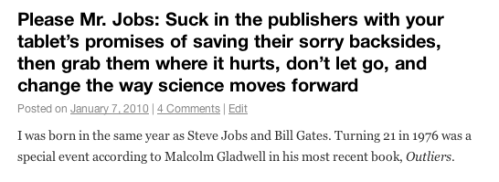
Some time back I wrote about this possibility here on this blog:

Click on the screenshot to go to the blog entry

Notice, will you, the date of this entry: January 7, 2010. The iPad 1 keynote was held on January 27, almost three weeks later, so at the time of writing we were still in the “tablet rumour” phase of iPad’s release.

But it seemed so certain that a tablet was on its way – although up to the day before no one guessed its name – that bloggers like me were already envisioning what its release would mean. For consumers and various industries too, such as publishing.

In my blog entry, this is what I wrote about scholarly publishing:

“Well, I’m saying the same thing to Steve Jobs: “Steve, mate, help science along by luring the publishing world in with a tablet as a lifeline to a dying industry, then grab them by the short and curlies like you did with the music industry!”

What I was referring to was the outlandish price of academic texts, both in book form, as well as downloadable articles for which the major publishing houses still charge anywhere between $25 and $35 for a PDF of perhaps only a few pages.

It’s wild-eyed pricing, given there are so many ways to obtain the same article, from writing directly to the lead author, going to their academic website where their publications are often listed for download, asking a friend with an academic position to get it for you, or using a search engine to eventually locate it. I would say 90% of the time I am successful with one of these methods within a few hours. Remember too, that authors get no royalties, and in some cases are prohibited from distributing their own published work as a condition of being published in a prestigious journal.

The other idea not unique to my thinking when contemplating the Apple tablet was self-publication, something which has been hinted at being included on Thursday, and for which Apple tools, like Pages, already exist, partially.

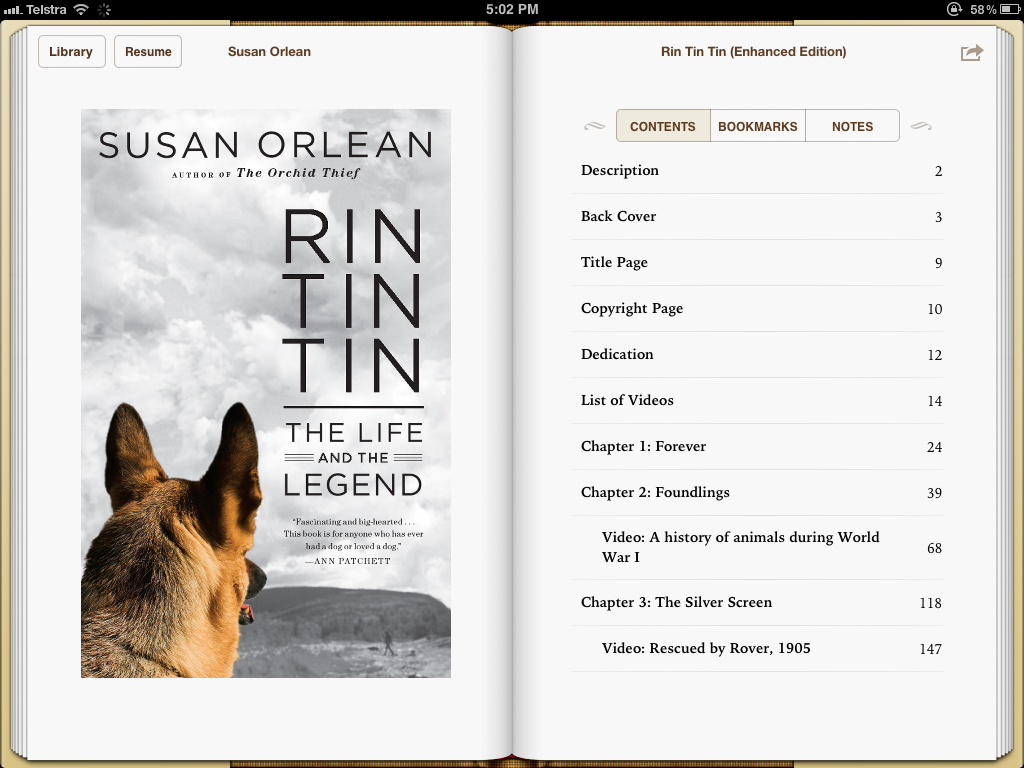
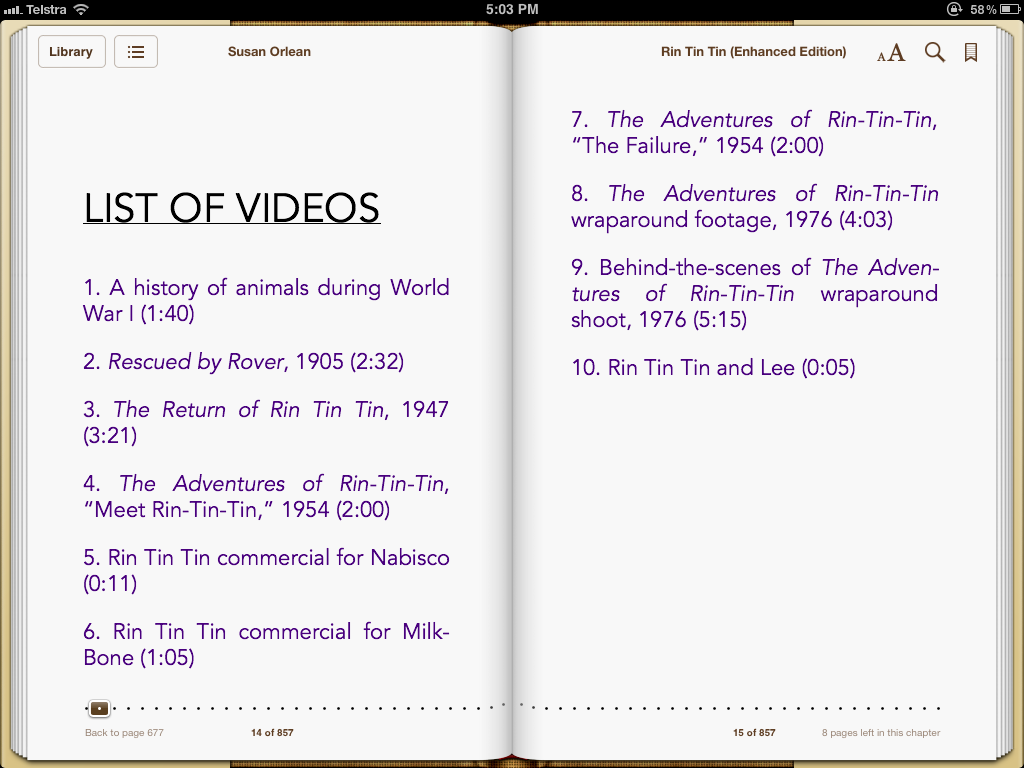
It seems the iPad is ideal for turning academic texts on their heads, including highly engaging visuals in enhanced versions. Late last year, I bought on iBooks an enhanced book about the dog, Rin Tin Tin, by Susan Orleans.

Note in the screenshot, below, both the book’s cover, and the list of videos within the book’s “covers” (page 14):

Cover and list of chapters

And if you go to Page 14, you’ll see the video listings:

List of Videos in Susan Orlean's Rin Tin Tin

And finally, without showing the movie in action, this is what it looks like, embedded, bearing in mind you can make the video full screen, as well as play it through Airplay to a monitor:

(UPDATE: My colleague Anthony Caruana asks about keeping open multiple books when say working on essays, as one does in analogue format. My response is that a beefed up iPad 3 may allow more multitasking, so that you can have multiple books open “behind” each other, and using an Misson Control-like  spread of the fingers, all the books can be seen, much like you can see all the apps or docs when using Mac OS X (below):

Hold the icon down in the Dock, and Show All Windows

Moreover, by using the iPad’s screenshot capabilities you can, as I have above, copy and paste in quotations from sources, to show you actually obtained them, rather than requoting from another source without sighting the original.)

I expect we may see a beefed up Pages announced on Thursday to assist the self-publishing process beyond its current format, and if that is the case, perhaps a reworked iWork 12 too – although it’s tiring to keep flogging a near moribund horse. Who knows, perhaps a new app. to be added to the iWork coterie.

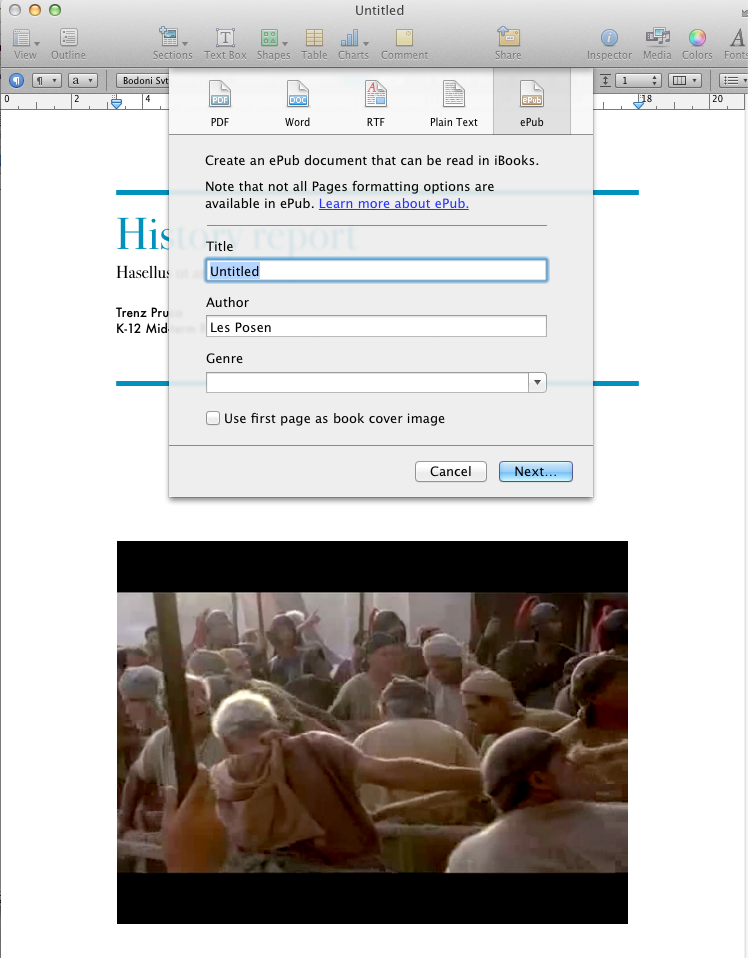
Creating an ePub in Pages is very limited, and indeed you cannot use the professionally created page layout templates Pages comes with to create an ePub. See below:

You can create a vanilla style document and insert video into it, and it will export to ePub format for transfer to an iDevice, like an iPad, using the word processor templates:

While you only see a still image, above, it’s actually a movie file I created for last year’s Macworld (Keynote on the iPad).

But that’s all well and good for private use and sharing. But what if I want to use Keynote and Pages to make a book for sale, perhaps starting with Presentation Magic using Keynote with all the effects and tutorials from my workshops? Rather than have handouts using lots of trees at workshops, why not gift my book for iPads and iPhones so that workshop attendees can either follow along (not my preferred option) or review the workshop afterwards with all the techniques I used explained and illustrated in much more detail?

And of course, the book is for sale on iBooks for a nominal price. Doesn’t this take self-publication to a whole new level? Yes, and like so many things Apple does, it’s been done before, but not this way and not this easily.

The next step is to take on the webinar, online training and Continuing Professional Education fields, which is worth billions.

Using the same tools authors use for their daily work, users could easily take their presentations and workshops and rework them for sale later without the extra expensive outside contractors needed to do it currently. Go and take a look at my APEX presentation of September 12, 2011, which I blogged about here.

The video I mention which is on YouTube was created using Keynote for the slides and presentation, my iPhone 4 to record the video and audio, and ScreenFlow to assemble the exported Keynote slides as a video and the iPhone output into a YouTube video.

This was a one person operation using inexpensive software, which easily lends itself to self-publishing workshops, and which can be value-added with an enhanced book for sale on iBooks Scholar (I just named it that). Perhaps Apple will release more tools for self-publishing a la Garageband integrating the output of Keynote, Pages and iMovie and then uploading them, like a podcast to iTunes University or the iBooks store.

The time is surely right to take on the world of science publishing, and I’m of the belief that this was in fact literally Steve Jobs’ dying wish – to disintermediate another industry which has become lazy and lacked innovation because no one dared stand up to it, much less the scientists who grasp the publishing industry’s teets for their tenured lives.

Publishing on Thursday and Television later in the year: it’s going to be a very interesting year in the science and creative arts in 2012.

[UPDATE: The website, 9-5Mac, reports an interesting juxtaposition occurring. An entry, without naming its author, suggests that Apple’s iWork Vice-President, Roger Rosner, has been transferred and “will be heading up the development of Apple’s entry into the textbook market.”

This is under Apple Senior VP, Eddy Cue, whose presenting style in Apple keynotes I’m no great fan of, but he is one heck of a smart operator, recently promoted, and I believe mentored by Steve Jobs, especially during the iTunes music rollout.

What this means for iWork is open for speculation. Will it mean tighter integration between iWork and Apple’s efforts to bring self-publishing tools to the marketplace in the form of Pages 5 (or iWork 12) or a new application, as suggested in my main blog entry, above? And what of Keynote? Abandoned or beefed up to to assist the creative aspects of self-publishing enhanced books, with audio, video and embedded animations, especially in textbooks?]

Aside

Stimulated by the interested shown in the solving of the Final Cut Pro X sneak peek keynote build effect, I’ve raced ahead and included two more Keynote files, this time of my own making. In the first, I feature something … Continue reading

A new build feature discovered in Keynote 12 or just some really smart Keynote authors working at Apple?

Welcome to the first blog post of 2012!

In the lead up to my two presentations at Macworld in a few weeks time, I’m creating some Keynote effects which I hope will tantalise and enchant my intended audience.

Since there will be more people reading this blog than will attend, I thought I’d use you as a guinea pig to beta test some of my ideas. I’m going to put up some Keynote effects over the course of the next few weeks until I depart for San Francisco. The challenge will be if you can work out how I did it – and whether you think they are effects worth demonstrating and teaching at Macworld.

I was thinking about this in December, but my accidental discovery of a video on Vimeo (I’ve been playing with the AppleTV over the hot, slow days of summer here in Australia) has moved the schedule forward.

In fact, the effect I’m going to show you is one I didn’t create, but one created for a “sneak peek” keynote at Supermeet NAB Las Vegas in mid-April before the official  launch of Final Cut Pro X in  June 2011.

Now even if you don’t use FCP X, but you’re an Apple follower, you’ll know the huge ruckus this rewrite created in the professional editing community, with many saying it was iMovie Pro or “iMovie on steroids”, lamenting the lack of compatibility with previous versions, the exclusion of much loved previous features, and so on. I’ve been predicting for a while now that Keynote too will get the FCP X “treatment” when its next upgrade is released, and that prediction is somewhat forged by Apple’s long time between updates suggesting a rewrite. And if Apple can do what it did to its professional users with FCP X, it will certainly have no second thoughts about Keynote, which is in desperate need of a rewrite too, if only to put a “Magic timeline” into being. It too might be called a Magnetic timeline as it is for FCP X, (see live link, below).

I want to feature a video from Vimeo taken at the Las Vegas sneak peek of FCP X, by Emanuel Pamperi. It shows FCP X’s chief architect, Peter Steinauer, going through some of its feature set, to much rousing applause (especially the price of $299!). That applause turned to dismay when the same crowd got its hands on FCP X in June, from previously mentioned reports. There were even “Hitler parodies” made, wondering what Apple was thinking when it made the serious changes it did! (Link: http://www.google.com.au/search?sourceid=chrome&ie=UTF-8&q=hitler+parody+final+cut)

Emanuel’s video is in two sections of 25 minutes, and you can see section 1 in its entirety here (but don’t go there just yet): http://vimeo.com/22329493

About 9:10 in Steinauer introduces new features known as Content Auto Analysis where FCP X analyses the raw data such as searching for faces or crowds or colour matching. I’ve taken the video and edited it so you see how he brings in each feature, starting with the raw source (an SD card) and its target (an iMac).

Here is the edited feature set below (edited, because it’s not in real time and there’s no sound track):

1. Notice how the sequence begins with three elements: SD Card -> iMac

2. The first feature – what would be a dreary bullet point in another presentation software – comes in, separating the SD card and iMac with move builds. Notice how the arrow duplicates and separates in the one build. Probably there were two arrows layered over each other in step 1, and each arrow moved as part of the build. (Well, that’s how I would have done it.)

3. New features are added from the bottom up in table format, again keeping the focus on the features in an animated fashion, rather than static bullet points.

4. But do you notice something I’ve not been able to duplicate? Each new cell of the table both dissolves in and moves upward as the whole table moves to make room? Please go back and have another look because it’s easy to miss.

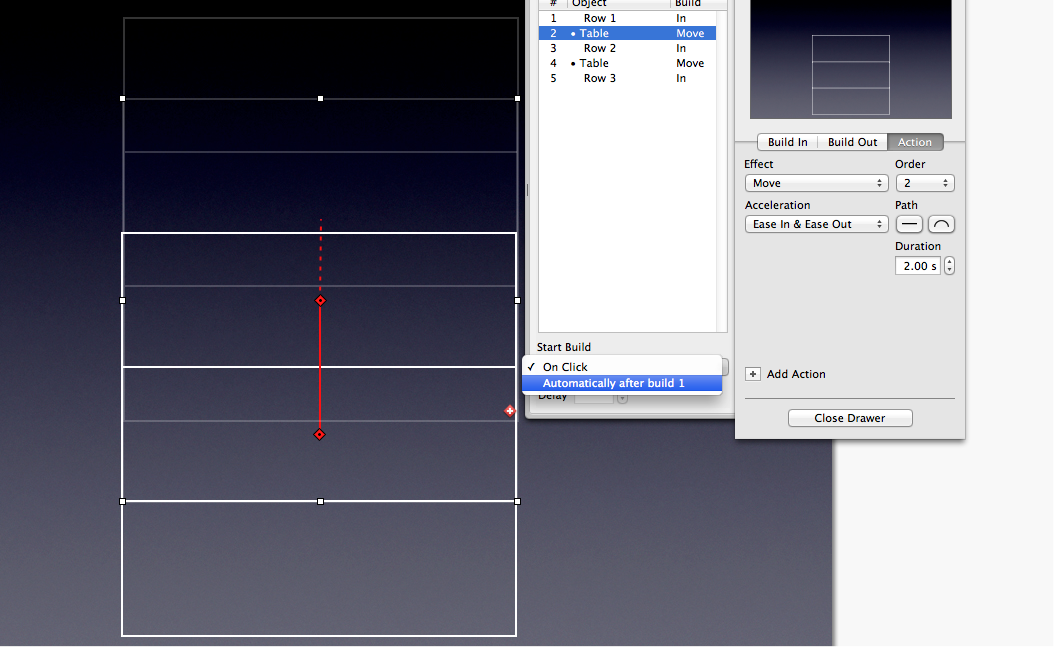
5. I’ve tried to reproduce this but Keynote 5 will not let a move and dissolve build together: it’s only after one build completes that the other build can occur, as the screen shot below shows. There is no Automatically with option.

6. So either I’m missing something, or what we saw at Las Vegas was a new Keynote feature, something I’m sure many of us could put to good use as we attempt to rid the world of bullet points!

I asked my esteemed Keynote colleague and theme creator John Driedger to have a go, and he came up with the same semi-solution as I did: we can move, then dissolve but not at the same time. (John will hopefully have some new themes and elements for me to show at Macworld).

So, over to you: Can you reproduce the effect here just using Keynote; do we have evidence of a new Keynote feature; or merely that the keynote author used a third party motion app to create the effect?

If you think you can do it in Keynote, email your Keynote file to me (lesatlesposen.com), I’ll verify it and post it as an update here. No prizes (yet!)

UPDATE (Jjanuary 5) : Problem solved using MagicMove and opacity controls. Well done to Spydre for suggesting this solution!

The vacuum left in presenting on things technology now that Steve Jobs has gone. Can All Things Digital’s Kara Swisher fill the gap? Um, er, No.

My preparations for Macworld 2012 are well and truly underway with flights booked, special guests invited, prizes being organised for attendees and reviewing my syllabus.

One of the things I’ve been doing in Presentation Magic workshops in 2011 is showing presentations by others and asking attendees to offer up a critical analysis of what they’re witnessing, based on the presentation principles so far addressed.

One of the primary sources for high quality presentations across a variety of styles and subjects has been the official TED website. Here, we’ve seen an increasing professionalism in the quality of both slides and presentation. Even Bill Gates has shown vast improvement.

Less so, but no less instructive, is the TEDx satellite circuit, where organisers can license the TED brand according to some very strict rules. Here, the quality control is much more varied, and occasionally one gets the feeling favours are offered to speakers by organisers. That was certainly my experience at the TEDx I attended in Canberra a few years back where I scratched my head at the inclusion of one or two speakers. Their presentations were poor, and seemed not to fit the theme of the day.

Moreover, the organisers had not thought to offer a vanity or confidence monitor for speakers, who continually turned their backs to the audience to view the screen behind them, some reading off their displayed slides. My tweets were very critical of the presentation style of some presenters.

This week, while on the lookout for more presentations to showcase at Macworld, I located the TedX BayArea Global Women Entrepreneurs event.

I was actually doing my usual search for all things Apple, when I located a talk at the event which mentioned Apple, by well known tech journalist, Kara Swisher.

I was aware of Kara’s work from her interviews with Steve Jobs, as well as her authoring a book quite a few years ago on the rise and fall of AOL, in which Apple had played a small part (if you recall eWorld).

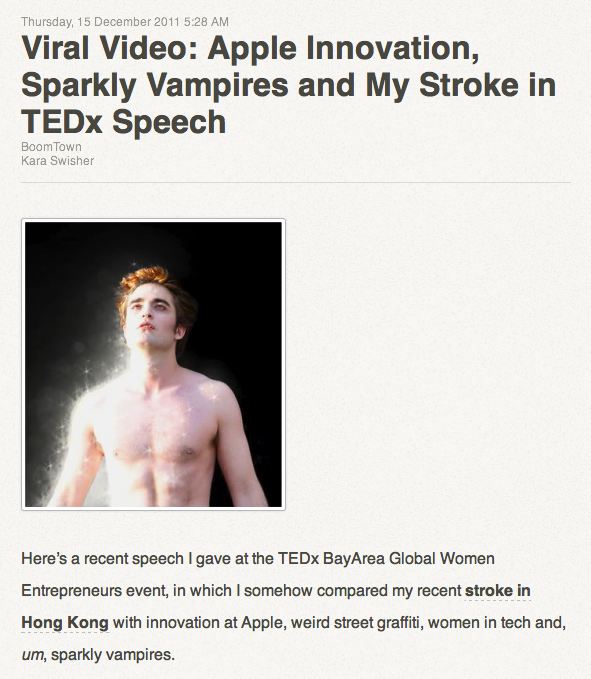
Her talk was entitled, More, and on her blog called BoomTown, which is an RSS feed I see each day, this is how she had described it:

I recalled that Kara had been indisposed for the All Things Digital event in Hong Kong recently where she had planned to share the stage with co-host Walt Mossberg. And I was aware she’d suffered a stroke. Her speech description intrigued me so I was prepared to sit back and watch her for the standard 18 minute Tedx Talk.

Here is the speech below, from the YouTube site. Watch all of it before you come back, or just the first five minutes and make a mental note of your emotional response to what you witness.

What did you notice?

For me, there were several things that felt like the proverbial fingernails down the blackboard sensation.

1. Did she start her speech by dissing her host for mispronouncing her name? Did this set the tone for a rather snarky speech that followed? There seems to be no one safe from her sarcasm: United Airlines, Microsoft, Rupert Murdoch (her employer) to name a few.

2. Kara was placed between two screens showing her slides and spend about 80% of her time looking at the screens, and not at the audience. Even when the slides were no longer relevant to the story she was telling.

3. Within fourteen seconds, the thing that most got in the way of her presentation made its presence felt: “Um”. There were other connectors too, such as “Er” and “you know” but these did not grate on me nearly as much as the incessant river of “Ums”.

Now these might go right under your attention radar because the content of the speech is riveting and engaging for you. But for me nowadays, I attend to both process and content. Not just what is being said, but how are the ideas being conveyed?

In Kara’s case,  I appreciated her attempts at sarcasm and the occasional self-depracating dig and had a laugh too. But there is a quantum of hubris in this speech which is unattractive and disengaging, not helped by the torrent of Ums.

Curiously, in her blog writeup of the speech she actually refers to her ums, viz:

“…women in tech, and, um, sparkly vampires.” (see screenshot, above).

So I decided to see what her talk would be like without the “ums” included, but leaving in other connectors and pauses. I imported the video downloaded from Firefox into iMovie and edited out all the ums. In a moment I’ll reveal how many there were in her 20″ speech.

You can see the results below, and do note that the video does jump about a little, so if this bothers you, just look away and listen, and ask if her speech flows better without the ums.

But the fun discovery was what I did with the edited elements. Sometime ago, I had work led on a Keynote project where we had to include a sound file of an interview. It was recorded in Garageband, and it was in there that I edited out long pauses, “you knows”, “ums” and long breaths to give the podcast some polish.

It sounded so much better and professional, smooth and flowing.

So in Kara’s case, I look all the out taken “ums” and put them together in chronological order. The resultant movie file is below, and I’ve topped and tailed it with the intro and finish elements. What’s astounding is both the number of “ums” and how much time they take up out of an 18″ speech (actually it was more like 20″).

So, how many “ums” were there? Watch the video below, and I’ll give you the number below it.

If you can be bothered counting, there are about 96 Ums which fully take up a minute of her allotted time. That’s 6% of her total speech in connectors.

A little analysis

There are many ways to think about these utterances. Rarely do they add to the comprehensibility of the speech. For a few of them, they are cues for the audience to laugh: “Hey, I’ve said something funny – this is where you laugh.” It allows the audience to take a moment to digest what’s just been said before Kara moves on. Stage actors in rehearsal without an audience need to know from the director sometimes when to pause when the audience is expected to laugh, otherwise the next funny line goes unheard.

Jack Benny would merely pause and look at the audience for it to be their cue to laugh.

Other shows of course employ a laugh track to goad us into enjoying the performances. And many other comedians have found their own way, from the raising of an eyebrow, or the curve of a lip, to let you know it’s OK to laugh at this point.

However, in Kara’s case there are less than a handful of these. Most of the ums are signatures of other less redeeming aspects of a presentation.

To my eyes and ears, these other ums and other connectors like “er” and “you know” are signs of under-preparedness, too little rehearsal, anxiety, and attempts to wing it, possibly in the belief that the spontaneous retelling of her story will suffice.

Let me be straight with you. I don’t rehearse all eight hours of my Presentation Magic workshops. I do rehearse each of the slides and how best to use it to tell my story. I don’t write the lines out, nor add them to my slides in Keynote’s presentation mode. Rather, every so often I’ll use the Post-It note style comment icon to remind me of the movie that’s coming next, or a factoid that I’ve forgotten on a previous occasion. But I don’t memorise every word. I simply rehearse – lots.

In a TED talk however, you’ve only got 18″ minutes to make your story count, no matter how famous you are. You need to be rehearsed and unless you’ve really got vast experience winging it, like a stage comedian dealing with hecklers, you’re better not hoping for the best on the day.

Kara’s “um’s”, snarkiness and her leaving her essential message right to the very end – it’s OK to work to your own schedule even if you’re ill  – requires her to use Steve Jobs to provide ultimate evidence of her belief. He arguably produced his most influential and lasting creations while fighting cancer, so anything’s possible if you apply yourself.

I tweeted Kara to say I had watched her speech but her “ums” needed some work, to which she replied shortly afterwards,  “forest, trees”. Our next tweets ended up with her reinforcing her point I simply didn’t understand her speech, and ultimately would never “get it”.

Kara’s a very influential person in the tech world, an employee of Rupert Murdoch’s, but ultimately when you get up on stage in front of a live audience and another one which may number in the thousands who’ll watch you for years to come on YouTube, you owe it to your audience to be rehearsed and prepared, especially if you want your story to be persuasive. I include modifying your idiosyncratic speaking style to minimise your off-putting connectors. It’s something I continue to work on for myself.

By the way, I did give some thought that perhaps her anxiety or frequency of “ums” was a possible aftermath of her stroke, but locating other speeches she’d given before the stroke suggest this is Kara’s usual speaking style.

Your thoughts? Am I making too big a deal out of this, or did I miss something that is important to you?

UPDATE: Two predictable responses on Twitter and on a blog.

@karaswisher asks on Twitter if I have nothing better to do (presuming she’s read the blog) and the simple answer is we’re on holidays here in Australia, so things are slow, and I am putting together my Macworld syllabus and Kara’s presentation is a possible inclusion. Many people do want to know how to control their speech style even in workshops on Keynote. It’s value adding.

Over on his personal blog, Jose de Silva essentially agrees with Kara that I’ve mistaken the forest for the trees and have lost sight of locating a presenter’s content. My counter-argument (which I would have written on his blog if comments were allowed) has always been that audiences should not be made to work so hard to decipher the message. That you can assist the transfer of learning process by making it easier through an understanding of adult models of learning (see the work of Richard Mayer for examples), stagecraft, design and rehearsal. Make an audience work too hard and no matter who you are or your subject, they will disengage and reach for their iPhones to play Angry Birds.

I agree with Jose about Kara’s being a superb journalist with a little snark, and perhaps not having time to better prepare her speech. Is this a sufficient explanation? No, it’s not. One can do both. (Or, to parallel Apple, don’t ship a product until it’s ready and capable). We can all do with a little help with our presentations, and I have only just missed out seeing Edward Tufte in New York January 23 because I booked my flights to Macworld too swiftly without checking Tufte’s 2012 schedule. My learning plan for this year is to see him and Stephen Few and really upskill my data visualisation prowess. This is especially as I’ll be targeting scientists and educators this year with my Presentation Magic workshops and blog. Finally, if you look around the various presentation blogs, I’m one of the few who puts up his unedited workshop evaluations in all their “glory”, not just positive testimonials.

You gotta take it if you’re gonna dish it!

Happy Holidays, Joe and Kara!

UPDATE: It may have something to do with this blog entry, but Kara has now blocked me from following her Twitter feed. Quelle domage.

The never ending pursuit of perfection: the parallel universes of Steve Jobs, management guru Peter Drucker, operatic composer Giuseppe Verdi, ancient Greek sculptor Phidias, and economist Joseph Schumpeter – lessons to be learnt about learning lessons applied to professional development and presentation skills

It’s been an interesting week leading up to the the American Thanksgiving holiday, which of course we acknowledge but don’t celebrate in Australia. This may come as a surprise to my American readers, since we Australians can also participate in the Black Friday sales which follow and mark the official start of the US festive season. It’s collateral good fortune.

In the past week, I’ve been featured in the Fairfax media MacMan column on my work with Apple’s Keynote presentation software (see it here). A small screen shot is below:

(Welcome to new readers who have followed me as a result of reading this article. Hopefully, your investment of time will pay off.)

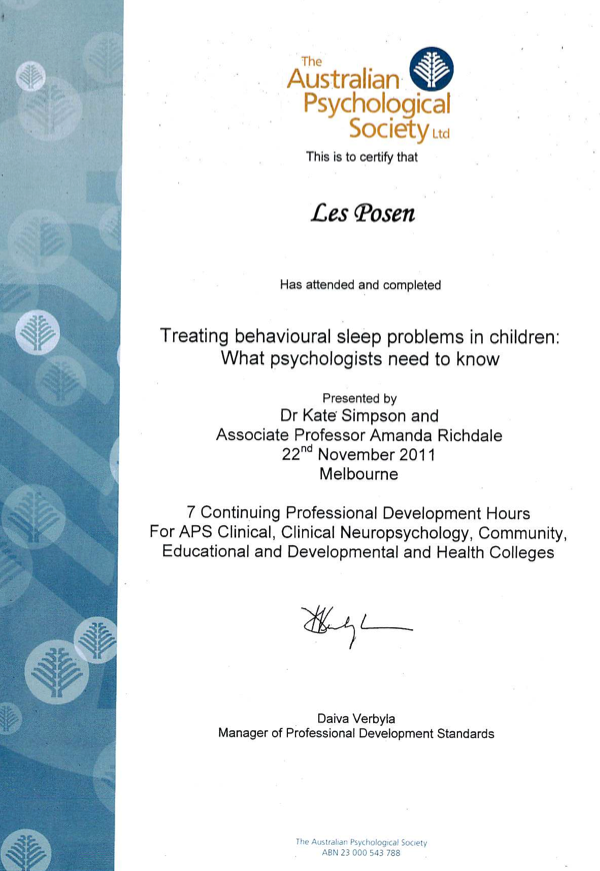
Also during the week, in an effort to maintain my professional development standing, where I must accumulate 30 hours of approved learning over a prescribed period, I attended a workshop sponsored by my professional society on Sleeping Disorders in Children. Here’s the Certifcate of Attendance below:

My professional development hours are mandatory in several ways. Without performing the necessary hours I would find myself in trouble with both my professional society, as well as my national registration body, and Medicare, Australia’s nationalised medicine scheme, where my patients can receive a rebate of in excess of $120 for each of 10 annual visits.

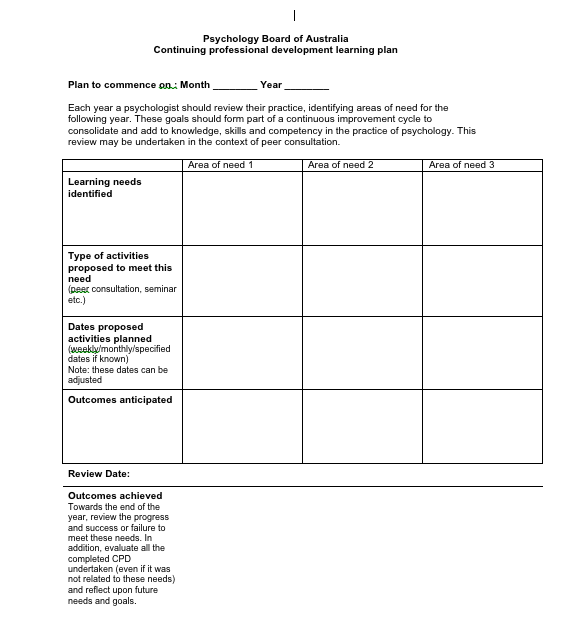
Each period of assessment which in this cycle lasts from July 2010 to November 2011, asks psychologists to provide at the outset a learning plan: What do you hope to learn about the professional practice of psychology during this period?

Below, is the exact form we are required to fill in at the commencement  of the professional development cycle:

In the case of the Sleeping Disorders workshop I undertook this week, it conforms with my training needs because one of the desires I have is to learn things about which I know very little or have no immediate practical need.

In the case of this workshop, I don’t believe I have ever seen a child for a sleep disorder in 30 years of clinical work. I’m not saying I haven’t seen a child with a sleep disorder – I have. It’s more that the referral has been for some other issue such as anxiety or depression of which sleep may be a component. So I don’t hang out a shingle that this is an area of specialisation but my desire to do the workshop was to challenge myself to attend a workshop for which there is no practical purpose. Strange, huh?

The purpose however reminds me of the times I have attended very expansive psychology conventions where there are more than 30 parallel sessions. While I’ll attend quite a few where I expect to apply any learning directly to my clinical practice, I’ll also attend other convention presentations to hear the “names” in my profession present, even if their field is not something I pay particular attention to –   who knows when I will ever have the same opportunity to hear them.

But I also wander into presentations whose fields I know nothing about, where I have minimal prior knowledge of the subject, and where I’m likely to not know the names of authors or experimenters being referenced, nor their body of work, nor the acronyms or special concepts. I enter de novo. As a teacher to psychologists (and others) of presentation skills, it’s a great opportunity to see leaders in their field, as well as first timers, present their stuff, and think about their presentation style and what I can learn for inclusion in my next workshop.

I must say however, that most times I attend psychology workshops and conventions, my learning is mainly what not to do, rather than come away thinking positively I really ought to include that in my workshop.

But going into those lectures with no prior background nor interest in how I will apply what I’ll witness (thus not needing to contemplate if I am up to date, or if my knowledge is sorely underwhelming i.e, the pressure is off) is truly liberating.

Without sitting in unconscious judgement of my own knowledge gaps, I am at liberty to think outside the box, or so I have discovered. I can make large intellectual leaps, because invariably what I learn ends up having some unpredicted relevance to my own work. I go in without pre-conceived ideas, with my only critical faculty being one of witnessing usually unimpressive presentation skills.

This phenomenon is well known to those who witness quantum leaps in understanding when two seemingly unconnected fields of knowledge come together. Each field’s “blindspots” are laid bare, their dogma of “it can’t be done” challenged by the other group’s unawareness of what has been tried and found to have – up to now – failed. The self-imposed limitations of one field are the challenges to another.

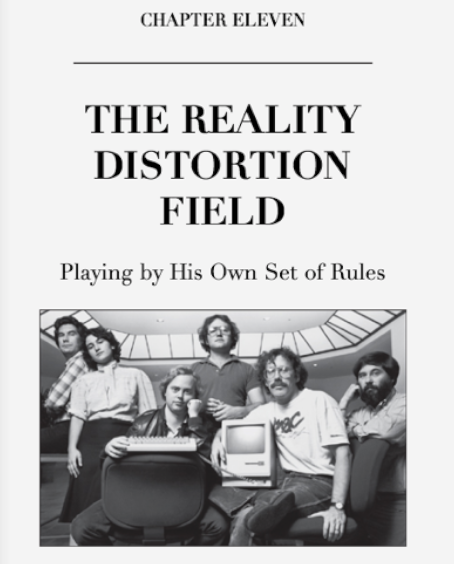
I was reminded of this with the reading of Steve Jobs’ authorised biography. The Macintosh group’s naming of Jobs’ Reality Distortion Field (RDF) (below) was not so much based on his salesmanship and marketing of Apple products, but his ability to convince his workers that what they thought was not possible, was possible.

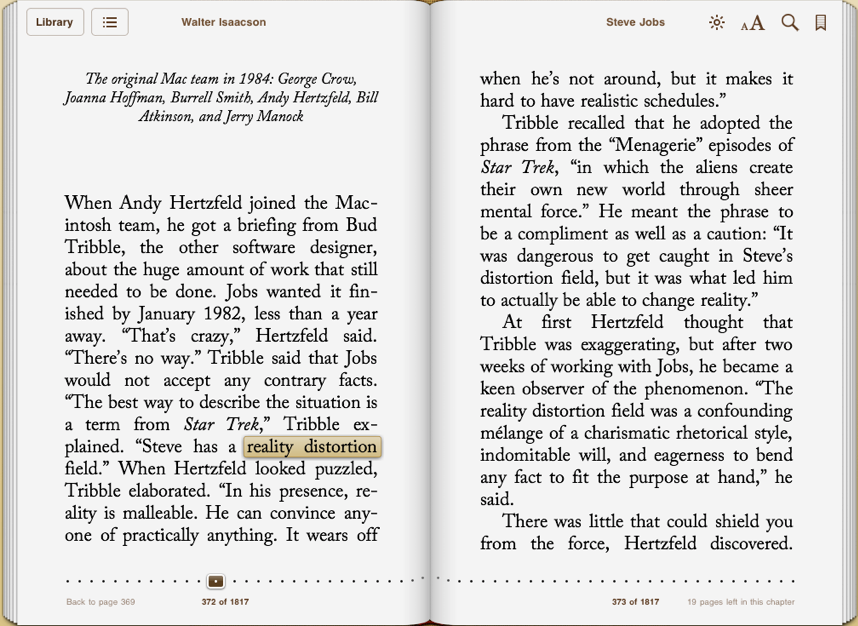
Shown above is the original Mac team from Walter Isaacson’s book, and the history of the RDF is described, thus:
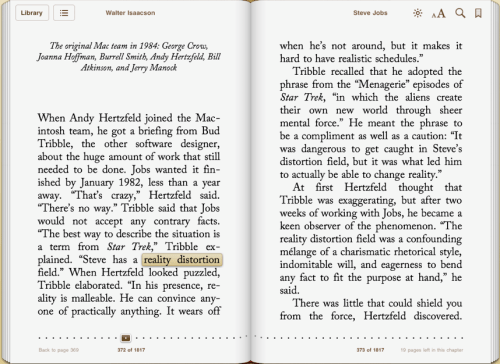
“Steve has a reality distortion field” (Bud Tribble)… “In his presence, reality is malleable. He can convince anyone of practically anything.”

There are several dozen references to the RDF in the biography, not just within Chapter 11. Of significance is its mention at the launch of Jobs’ NeXT computer in the time he was away from Apple.

Demonstrating why the NeXT “(had) made the first real digital books”, Jobs said: “There has not been an advancement in the state of the printed book technology since Gutenberg”. (Even though the NeXT failed commercially, Jobs desire to revolutionise the printed book and turn another industry on its head lives on in the shape of the iPad.)

While demonstrating the NeXT, Isaacson writes of Jobs:

“… he used the quotations book to make a more subtle point,  about his reality distortion field. The quote he chose was from Lewis Carroll’s Through the Looking Glass (orig. ital.). After Alice laments that no matter how hard she tries she can’t believe impossible things, the White Queen retorts, “Why, sometimes I’ve believed as many as six impossible things before breakfast.” Especially from the front rows (of the NeXT demonstration audience), there were roars of knowing laughter.”

The idea of professions learning from each other, and respecting how each can make a contribution, is well known in health care, where patients may well be seen by several different health practitioners who care about the global health of the patient, rather than their own specialisation.

To work together, the professions must learn about each other, and this has become known as InterProfessional Education (IPE).

Take a look at this definition from Western University:

PE is generally accepted to mean

“Occasions when (students) from two or more professions learn with, from and about each other to improve collaboration and the quality of care”.

– Freeth et al. Effective Interprofessional Education:
Development, Delivery & Evaluation
. Blackwell Publishing, Oxford, UK, 2005.

The World Health Organization recently described IPE and collaborative practice is to mean. “Interprofessional education occurs when students from two or more professions learn about, from and with each other to enable effective collaboration and improve health outcomes. Interprofessional education is a necessary step in preparing a ‘collaborative practice-ready’ health workforce that is better prepared to respond to local health needs. Source: World Health Organization (2010): Framework for Action on Interprofessional Education & Collaborative Practice”.

This is, by the way, why I was unhappy when my professional society wished to set up a mentor scheme for young psychologists and only wanted psychologists as mentors. I advised it would be too easy to confuse it with professional supervision, and mentoring would be best handled by experienced professionals outside of the practice of psychology. (That fell on deaf ears).

Let me now bring in the notion of Continuing Professional Education. My national registration body insists that:

“As a general guide, CPD (continuing professional development) activities should be relevant to the psychologist’s area of professional practice and have clear learning aims and objectives that meet the individual’s requirements”.

This of course leaves it wide open to argue what is defined as “relevant”, and indeed to even define what is a professional practice.

If for instance, I advertise my presentation skills training as almost unique in that few psychologists offer this training, and that my knowledge as a practising psychologist (spending 30 years persuading people to change) makes my workshops special, would my attending say Garr Reynolds Presentation Zen workshops which focusses less on my area of psychology and more on design theory be considered irrelevant?

But there is more to interprofessional collaboration and the gains to be made that just patient care. Surgeons and commercial pilots are getting together on a frequent and formal basis to learn about risk management mitigation strategies and preparedness, as I learnt from one fear of flying physician patient and his father who was a leading surgeon. He had brought his College of Surgeons and Qantas Safety culture experts together to learn from each other.

Going still further, yet returning to the point of one profession’s self-limitating beliefs and behaviours being challenged by collaborating with another profession, let me draw your attention to the book, below:

Hargadon’s book can be accessed in part from Googlebooks here but here’s an early main point:

This of course is why so many have compared Steve Jobs to Edison for their shared abilities to recognise the nature of innovation, bring disparate people together, and then in Jobs’ case in particular, get them to see beyond their own self-imposed limitations, not just their own profession’s with which they identify, and for which there can be various stigma applied if one steps out of prescribed, but often not coded, limits. I’ve been there, and done that with regard to my own profession, especially the application of technologies in psychological endeavours.

Also during the week, based on the article appearing in the media featuring my ideas on presenting and Keynote, I was contacted by a young psychologist (let’s call her by a nom de plume: Nicky) involved in a committee putting on a two day conference at which she was due to present on her Ph.D. Nicky asked if I would provide some coaching in constructing her message.

Not surprisingly, when I loaded her Powerpoint onto my Macbook Pro and projected it up on the wall, it contain the usual presentation errors I ask psychologists and other scientists to give consideration to: loads of text, small pixelated images of dubious relevance, lack of clarity as to the central message, overuse of concepts which needed further clarification before making the central point, disengaging use of article citations and their page numbers, and so on.

(At my Presentation Magic workshop at Macworld 2012, I’ll show for those in academia how to do this properly. My client, like so many I see, know that many presentations leave something to be desired, but have little idea what to do about it. The sooner those who train professionals understand that presentation skills is a teachable subject in demand for professional development, the sooner it will be included in syllabi, and the sooner presentations will improve. Based on the feedback I received a this year’s American Psychological Association convention in Washington, I completed the onerous task of applying to do a Presentation Magic workshop for continuing education for the APA Orlando convention, in August 2012.)

When I showed Nicky how I illustrate references, quotations, book titles and other devices using Keynote’s bag of tricks, she was wowed (as I expected). She “got it” immediately as most do when shown “before and after” slide modifications and we even worked through some simple transformations she could make before her presentation this week. All from an evidence-base.

Here’s her thank you email, with her ID obscured:

The good thing is both Nicky and I earn CPD points for this endeavour. (Update: I heard from Nicky her presentation went well and she is eager to return and play on her own with Keynote)

But today, through an obscure RSS feed, I came across a reference to the work of management guru, Peter Drucker. Published in INC., in 1997, his article entitled, My life as a Knowledge Worker, describes “seven personal experiences that taught (Drucker) how to grow, to change, and to age–without becoming a prisoner of the past”. The article itself is an adaptation from a 1996 book:  Drucker on Asia: The Drucker-Nakauchi Dialogue , by Peter F. Drucker and Isao Nakauchi,

I’m at an age and experience in my own profession where such articles draw me to them like a moth to a flame. And as you will see, there are parallels between Drucker as a management innovator, and that of Steve Jobs – uncannily so.

The First Parallel to Steve Jobs

Here is Drucker writing about his first experience:

THE FIRST EXPERIENCE 
Taught by Verdi

The work at the export firm was terribly boring, and I learned very little. Work began at 7:30 in the morning and was over at 4 in the afternoon on weekdays and at noon on Saturdays. So I had lots of free time. Once a week I went to the opera.

On one of those evenings I went to hear an opera by the great 19th-century Italian composer, Giuseppe Verdi–the last opera he wrote, Falstaff. It has now become one of Verdi’s most popular operas, but it was rarely performed then. Both singers and audiences thought it too difficult. I was totally overwhelmed by it. Although I had heard a great many operas, I had never heard anything like that. I have never forgotten the impression that evening made on me.

When I made a study, I found that this opera, with its gaiety, its zest for life, and its incredible vitality, was written by a man of 80! To me 80 was an incredible age. Then I read what Verdi himself had written when he was asked why, at that age, when he was already a famous man and considered one of the foremost opera composers of his century, he had taken on the hard work of writing one more opera, and an exceedingly demanding one. “All my life as a musician,” he wrote, “I have striven for perfection. It has always eluded me. I surely had an obligation to make one more try.”

I have never forgotten those words–they made an indelible impression on me. When he was 18 Verdi was already a seasoned musician. I had no idea what I would become, except that I knew by that time that I was unlikely to be a success exporting cotton textiles. But I resolved that whatever my life’s work would be, Verdi’s words would be my lodestar. I resolved that if I ever reached an advanced age, I would not give up but would keep on. In the meantime I would strive for perfection, even though, as I well knew, it would surely always elude me. (Italics added).

The Second Parallel to Steve Jobs

In his second experience, Drucker elaborates on this quixotic quest for perfection, and goes back in history much past Verdi. If you haven’t read Isaacson’s book yet, many of those who criticise him for a lost opportunity to really help us understand Jobs, point to Isaacson’s not immersing himself in technology history to place Jobs’ development into an appropriate perspective. We read of some clues however (click to enlarge):

The pride in workmanship is perhaps what has differentiated Apple from its competitors in the world of technology. It causes many who don’t understand why some prefer to pay that little extra to be label them as “sheeple” or Apple “Fanbois” or more affectionately within the Apple community as “MacMacs”.

But to drive the point home in the world of presentations, many who attend my workshops “complain” of my work ethic, with respect to labouring for hours over a slide which might only be on the screen for a few moments. Academics in particular claim they do not have the time to invest in their slides, hence their proclivity to “cut and paste” text from Word documents into Powerpoint slides, denude it of verbs and appropriate grammar, and shove a bullet point in front of the text.

I labour over my slides because I make the time to do so; I want the audience to understand I value their attendance and a high quality engaging slideshow is their reward; constructing difficult slides requires me to both understand the message I want to deliver as well as dig down deep into the software I choose to use to really understand its strengths and weaknesses. The latter get reported, with examples of what I want to happen, to Apple’s iWork team.

Finally, a slide or series of slides that work well can be repurposed for another presentation with a simple substituting of words and graphics, keeping the builds and transitions intact.

So what does the back of a cabinet made by Steve Jobs’ father have to do with Peter Drucker?

In his second learning experience to become a knowledge worker, Drucker writes:

THE SECOND EXPERIENCE 
Taught by Phidias

It was at about this same time, and also in Hamburg during my stay as a trainee, that I read a story that conveyed to me what perfection means. It is a story of the greatest sculptor of ancient Greece, Phidias. He was commissioned around 440 b.c. to make the statues that to this day stand on the roof of the Parthenon, in Athens. They are considered among the greatest sculptures of the Western tradition, but when Phidias submitted his bill, the city accountant of Athens refused to pay it. “These statues,” the accountant said, “stand on the roof of the temple, and on the highest hill in Athens. Nobody can see anything but their fronts. Yet you have charged us for sculpting them in the round–that is, for doing their back sides, which nobody can see.”

“You are wrong,” Phidias retorted. “The gods can see them.” I read this, as I remember, shortly after I had listened to Falstaff, and it hit me hard. I have not always lived up to it. I have done many things that I hope the gods will not notice, but I have always known that one has to strive for perfection even if only the gods notice.

Need I say more?

The Third Parallel to Steve Jobs
Jobs was relentless in his pursuit of change, not for the sake of it, but to discard even successful products and services when new technologies and materials became available. Others might have “stuck to a good thing” and milked a cash cow for all it was worth without engaging in much innovation, especially if the product had a near-monopoly hold in the marketplace. This was not Jobs’ way, and many were astonished when years ago he dumped Apple’s most successful iPod at the time, the iPod-mini,  for the iPod Nano. The iPod-mini had itself been panned by critics at each launch.
When all around Apple were griping about Global Financial crises, Jobs said Apple would innovate its way out of the financial mess the world found itself in. In 2001, introducing the iTunes Music store, he famously said:
“We decided to innovate our way through this downturn, so that we would be further ahead of our competitors when things turn up.”
Drucker too had been through a financial crisis having worked in Europe for a financial  brokerage firm at the time of the Great Wall Street Crash of October, 1929. Aged 20 at the time, he left finance to continue studies in law while learning to become a journalist. The latter taught him one of several lessons he continued to employ throughout his life. It supports my notion of delving into fields you know nothing about which can teach you more than alleged “relevant” continuing professional education:

THE THIRD EXPERIENCE 
Taught by Journalism

A few years later I moved to Frankfurt. I worked first as a trainee in a brokerage firm. Then, after the New York stock-market crash, in October 1929, when the brokerage firm went bankrupt, I was hired on my 20th birthday by Frankfurt’s largest newspaper as a financial and foreign-affairs writer. I continued to be enrolled as a law student at the university because in those days one could easily transfer from one European university to any other. I still was not interested in the law, but I remembered the lessons of Verdi and of Phidias. A journalist has to write about many subjects, so I decided I had to know something about many subjects to be at least a competent journalist.

The newspaper I worked for came out in the afternoon. We began work at 6 in the morning and finished by a quarter past 2 in the afternoon, when the last edition went to press. So I began to force myself to study afternoons and evenings: international relations and international law; the history of social and legal institutions; finance; and so on. Gradually, I developed a system. I still adhere to it. Every three or four years I pick a new subject. It may be Japanese art; it may be economics. Three years of study are by no means enough to master a subject, but they are enough to understand it. So for more than 60 years I have kept on studying one subject at a time. That not only has given me a substantial fund of knowledge. It has also forced me to be open to new disciplines and new approaches and new methods–for every one of the subjects I have studied makes different assumptions and employs a different methodology.

Again, the parallels to how Jobs conducted his life are clear. In terms of relevance to me as a professional, I have always asserted that Professional associations and societies and Registration Boards who assert CPD is good for protecting the public from out of date practitioners have badly sold CPD: it’s as much about the welfare of the practitioner as it is about the welfare of the profession and the public it serves. Unfortunately, too often I see sticks and not carrots in this domain. As agents of change, we psychologists have much to learn in this domain.

The Fourth Parallel to Steve Jobs

By now, if you are at all interested in presentations, Steve Jobs and Apple, you will be aware of what a terribly difficult person he could be, especially when leading his teams to produce the products he believed the public wanted to buy, although they didn’t know it yet. He wanted others to participate in his singular pursuit of perfection.  I must say, I have had the occasional person witness my presentations and ask me, “Why do you bother? Why spend time chasing down the one picture to illustrate your idea, and why not make do with a standard presentation style, like we all do?”
Here is Drucker writing of turning his journalism career into lifetime lessons, with a special emphasis on mentoring, training and learning from others with an eye to perfection:

THE FOURTH EXPERIENCE 
Taught by an Editor-in-Chief

The next experience to report in this story of keeping myself intellectually alive and growing is something that was taught by an editor-in-chief, one of Europe‘s leading newspapermen. The editorial staff at the newspaper consisted of very young people. At age 22 I became one of the three assistant managing editors. The reason was not that I was particularly good. In fact, I never became a first-rate daily journalist. But in those years, around 1930, the people who should have held the kind of position I had–people age 35 or so–were not available in Europe. They had been killed in World War I. Even highly responsible positions had to be filled by young people like me.

The editor-in-chief, then around 50, took infinite pains to train and discipline his young crew. He discussed with each of us every week the work we had done. Twice a year, right after New Year’s and then again before summer vacations began in June, we would spend a Saturday afternoon and all of Sunday discussing our work over the preceding six months. The editor would always start out with the things we had done well. Then he would proceed to the things we had tried to do well. Next he reviewed the things where we had not tried hard enough. And finally, he would subject us to a scathing critique of the things we had done badly or had failed to do. The last two hours of that session would then serve as a projection of our work for the next six months: What were the things on which we should concentrate? What were the things we should improve? What were the things each of us needed to learn? And a week later each of us was expected to submit to the editor-in-chief our new program of work and learning for the next six months. I tremendously enjoyed the sessions, but I forgot them as soon as I left the paper.

Almost 10 years later, after I had come to the United States, I remembered them. It was in the early 1940s, after I had become a senior professor, started my own consulting practice, and begun to publish major books. Since then I have set aside two weeks every summer in which to review my work during the preceding year, beginning with the things I did well but could or should have done better, down to the things I did poorly and the things I should have done but did not do. I decide what my priorities should be in my consulting work, in my writing, and in my teaching. I have never once truly lived up to the plan I make each August, but it has forced me to live up to Verdi’s injunction to strive for perfection, even though “it has always eluded me” and still does.

Most Fridays, I prefer not to see patients, instead writing reports, blogging, reading, and reflecting with colleagues on how the week went: What did I learn from my patients this week; what of the presentation I gave last weekend – could it be improved knowing what worked and what didn’t and the audience reactions to both. It doesn’t give me a long weekend, as I’m often flying with patients on Saturday or Sunday to help them overcome their fear of flying. But this time for reflection and solitude is very important.
The first time I saw Steve Jobs on the Apple Cupertino campus I was being hosted at lunch by one of the iWork senior staff, and there was Steve, about 100 metres away, walking alone around the campus, deep in thought. He was very thin at the time, somewhat stooped, but you could almost hear the cogs of his mind ticking over like an exquisite Swiss timepiece.
I’ve thought that with my current crop of supervisees we should sit down in our next session and work though their new professional learning plan, as mandated by the national registration board, get the signed paperwork out of the way, and work assiduously to NOT do it, but exceeding it in some unpredictable yet justifiable way. As Drucker noted, after six decades, he never succeeded with his plans, such was his striving for perfection, and the limitations such planning can embrace.
The Fifth Parallel to Steve Jobs
One of the important things that I do for my own learning, both as a psychologist and a presenter, is watch how experts work. It could be going to lectures and workshops by people at the top of their profession, but whose body of work I have only passing interest in. Sooner or later, an expert will teach you something. But as Alan Funt would say, it may happen when you least expect it.
Or it could be watching advertisements or those current affairs shows which each have limited time to get across their messages, usually aiming at the lowest common denominator. They need to pull out all the technology and story telling stops to do so, and I watch very closely how they do this, and wonder if I can emulate them in Keynote. Other times, I watch high brow documentaries for the same reason, and more and more we are seeing amazing CGI to get across very complex ideas. Please locate Brian Green’s NOVA documentary series, Fabric of the Universe,  to see what I am talking about, here.
Apart from having a deep foundational knowledge of their subject, experts have the ability to impart that knowledge to others who only possess superficial knowledge. They also possess a methodology for confronting data points which do not conform to their deep structural knowledge of  their subject. They are not frightened of their theories being challenged but instead, embrace the challenge in an effort to advance the science, and thus the profession. While they have a healthy appreciation of how their expertise developed, they do not look to history to provide the way forward; instead, they are quick to see it as irrelevant if the current facts negate that history. True expertise I believe is not adhering to old ways of doing things if the current evidence shows those ways to be false.
In my own profession, too often have I seen patients who have consulted colleagues who spent considerable time going through childhood history seeking the aetiology of the presenting concern. It’s a luxury we in Australia no longer have as this month rebated sessions under our socialised Better Access to Psychologists scheme have been cut from an annual maximum of 18, to a maximum of 10. The evidence base which saw psychologists’ services enter the Medicare system in the first place in 2006 is one that shows mild to moderate (and sometime severe) impairments, such as anxiety and depression, require between 16 and 20 sessions from a competent psychologist for significant and lasting change to occur.
I have always worked briefly, but ten sessions is getting very close to pushing me to my limits, even though I aim to achieve significant results in 6 to 8 sessions, leaving several sessions up our sleeves for follow up, and unexpected setbacks.
I don’t bring a great deal of focus to childhood origins and behaviour, but prefer to hear the patient’s theories of why their situation has presented itself, what they believe is needed to change that, how they know when change has been effected, and most importantly what factors are maintaining the current misery-causing situations, since they will become our targets for change. Occasionally, patients go back to parents or other figures of their childhood and get their side of the story. This sometimes sees a revision of their own story, but rarely does this cause an epiphany leading to behavioural change. That still requires work.
How change takes place is really what I do, both with my patients and those who attend Presentation Magic training, for whom the task is convincing them to move away from the tradition and style of disengaging Powerpoint to something more effective and rewarding.
Steve Jobs was one to rarely look back, and his biography and commentary about him focusses on his lack of nostalgia (except for his family) and his relentless pursuit of the new, because it would provide a better answer to problems than the old.
Drucker too talks about the old and the new:

THE FIFTH EXPERIENCE 
Taught by a Senior Partner

My next learning experience came a few years after my experience on the newspaper. From Frankfurt I moved to London in 1933, first working as a securities analyst in a large insurance company and then, a year later, moving to a small but fast-growing private bank as an economist and the executive secretary to the three senior partners. One, the founder, was a man in his seventies; the two others were in their midthirties. At first I worked exclusively with the two younger men, but after I had been with the firm some three months or so, the founder called me into his office and said, “I didn’t think much of you when you came here and still don’t think much of you, but you are even more stupid than I thought you would be, and much more stupid than you have any right to be.” Since the two younger partners had been praising me to the skies each day, I was dumbfounded.

And then the old gentlemen said, “I understand you did very good securities analysis at the insurance company. But if we had wanted you to do securities-analysis work, we would have left you where you were. You are now the executive secretary to the partners, yet you continue to do securities analysis. What should you be doing now, to be effective in your new job?” I was furious, but still I realized that the old man was right. I totally changed my behavior and my work. Since then, when I have a new assignment, I ask myself the question, “What do I need to do, now that I have a new assignment, to be effective?” Every time, it is something different. Discovering what it is requires concentration on the things that are crucial to the new challenge, the new job, the new task.

The Sixth Parallel to Steve Jobs

One of the things Jobs became legendary for was his focus. In particular, how to take a product or service and remove all that was unnecessary to the task, such as flashing lights and shiny decals, and make sure form matched function. If you into an Apple store you will experience this focus, bot just by playing with the products but in the actual customer service itself.

Jobs played to his strengths, focussing when he returned to Apple in 1997 (the year Drucker wrote his article) on simplifying the product line, which had grown to monstrous and unprofitable proportions under previous Apple CEOs.

Jobs wanted Apple’s return to its roots, to design and make the sort of products he had conceived of at Apple’s birth: ones that could cause massive change in how people worked.

While others around him had wanted Apple to compete with the “Wintel” (Windows on Intel powered PCs)  juggernaut by cloning the Apple operating software to other PC makers, Jobs killed those programs at great expense to focus on what he believed Apple did best.

Rather than a chase to the bottom of the barrel where profits were wafer thin and based on selling masses of “what everybody else is doing” products, Jobs went for the higher ground, knowing – as it was for his favourite auto maker, Mercedes Benz – that there will always be a market for high quality luxury goods where handsome profits can also be made. In time, the quality of the higher end, expensive products would filter down into less expensive, more easily afforded goods, such as the iPod Shuffle, an inexpensive iPod to groom young people into buying Apple products. To fill their Shuffles, they needed iTunes and its downloadable music. And when they could afford it, Macintosh desktop and laptop computers.

When it comes to presentations, I too play to my strengths, daring myself to take risks, to challenge my audience, and not give in to the lowest common denominator, even if it cancelling a presentation to a conference audience whose organisers demand I convert my Keynotes to Powerpoint for their convenience, not for the edification of the paying attendees.

Thus, Drucker too talks about playing to one’s strengths, and the role of continuous learning:

THE SIXTH EXPERIENCE 
Taught by the Jesuits and the Calvinists

Quite a few years later, around 1945, after I had moved from England to the United States in 1937, I picked for my three-year study subject early modern European history, especially the 15th and 16th centuries. I found that two European institutions had become dominant forces in Europe: the Jesuit Order in the Catholic South and the Calvinist Church in the Protestant North. Both were founded independently in 1536. Both adopted the same learning discipline.

Whenever a Jesuit priest or a Calvinist pastor does anything of significance–making a key decision, for instance–he is expected to write down what results he anticipates. Nine months later he traces back from the actual results to those anticipations. That very soon shows him what he did well and what his strengths are. It also shows him what he has to learn and what habits he has to change. Finally, it shows him what he has no gift for and cannot do well. I have followed that method for myself now for 50 years. It brings out what one’s strengths are–and that is the most important thing an individual can know about himself or herself. It brings out areas where improvement is needed and suggests what kind of improvement is needed. Finally, it brings out things an individual cannot do and therefore should not even try to do. To know one’s strengths, to know how to improve them, and to know what one cannot do–they are the keys to continuous learning.

The Seventh Parallel to Steve Jobs

The final parallel is perhaps the most haunting and significant one. Here, in the final installment of his seven learning experiences, Drucker writes of he and his father visiting the great economist, Joseph Schumpeter, who had been a co-worker of his father’s in Europe when both were very young. When he writes of comparing his father to Schumpeter, (below) I am reminded in his description of Steve Jobs and Steve Wozniak, and their contrasting personalities.

In this learning lesson, Drucker uses his visit to Schumpeter to review lessons learnt of a lifetime, of what’s important, and of giving consideration to one’s legacy to one’s fellow human beings. This would appear to have been an increasingly important concept  for Jobs too, as he oversaw the return of Apple to past glories, and indeed way beyond most people’s expectations. Having achieved incredible fame and fortune, he turned his attention to his legacy, both to Apple and mankind.

This phrasing might irk many people, but it certainly helps explain the unconstrained outpouring of grief and sorrow at Jobs’ passing only seven weeks ago, with so much ahead of him to yet achieve.

But once he knew he had to get his affairs in order, as he had been told early in his diagnosis of cancer, he went about it methodically and with an eye to his legacy. No doubt, he first thought of his family and how to care for them in his absence, and to some extent Isaacson’s book is meant to be a source of care for his children, to help explain his absences from important developments in their lives.

But he also turned his attention to the bigger picture of Apple itself, and how to leave the company he’d co-founded when he was 21, in good hands and with a culture  and ability to strategise that would long outlive him. Not so much in his image (he didn’t want a “What would Walt do” paralysis which afflicted Disney after his passing), but in his pursuit of perfection, continuous learning, and making products and services which make a difference in people’s lives. It’s no surprise then that he set up a Knowledge Management program – Apple University – to impart his life’s learnings, through the leadership of Yale’s Joel Podolny.

No doubt Podolny, like most in American business schools, was a student of Drucker’s even if he never sat in a class of his. Drucker was a force to be reckoned with, changing the face of American and world business practices over the course of his lifetime. Here is his seventh and most parallel of learning experiences:

THE SEVENTH EXPERIENCE 
Taught by Schumpeter

One more experience, and then I am through with the story of my personal development. At Christmas 1949, when I had just begun to teach management at New York University, my father, then 73 years old, came to visit us from California. Right after New Year’s, on January 3, 1950, he and I went to visit an old friend of his, the famous economist Joseph Schumpeter. My father had already retired, but Schumpeter, then 66 and world famous, was still teaching at Harvard and was very active as the president of the American Economic Association.

In 1902 my father was a very young civil servant in the Austrian Ministry of Finance, but he also did some teaching in economics at the university. Thus he had come to know Schumpeter, who was then, at age 19, the most brilliant of the young students. Two more-different people are hard to imagine: Schumpeter was flamboyant, arrogant, abrasive, and vain; my father was quiet, the soul of courtesy, and modest to the point of being self-effacing. Still, the two became fast friends and remained fast friends.

By 1949 Schumpeter had become a very different person. In his last year of teaching at Harvard, he was at the peak of his fame. The two old men had a wonderful time together, reminiscing about the old days. Suddenly, my father asked with a chuckle, “Joseph, do you still talk about what you want to be remembered for?” Schumpeter broke out in loud laughter. For Schumpeter was notorious for having said, when he was 30 or so and had published the first two of his great economics books, that what he really wanted to be remembered for was having been “Europe’s greatest lover of beautiful women and Europe’s greatest horseman–and perhaps also the world’s greatest economist.” Schumpeter said, “Yes, this question is still important to me, but I now answer it differently. I want to be remembered as having been the teacher who converted half a dozen brilliant students into first-rate economists.”

He must have seen an amazed look on my father’s face, because he continued, “You know, Adolph, I have now reached the age where I know that being remembered for books and theories is not enough. One does not make a difference unless it is a difference in the lives of people.” One reason my father had gone to see Schumpeter was that it was known that the economist was very sick and would not live long. Schumpeter died five days after we visited him.

I have never forgotten that conversation. I learned from it three things: First, one has to ask oneself what one wants to be remembered for. Second, that should change. It should change both with one’s own maturity and with changes in the world. Finally, one thing worth being remembered for is the difference one makes in the lives of people.

I am telling this long story for a simple reason. All the people I know who have managed to remain effective during a long life have learned pretty much the same things I learned. That applies to effective business executives and to scholars, to top-ranking military people and to first-rate physicians, to teachers and to artists. Whenever I work with a person, I try to find out to what the individual attributes his or her success. I am invariably told stories that are remarkably like mine.

Your observations and comments about your own learning experiences, for the education of others, is welcomed, below.