Category Archives: Presentation Skills

Excitement and anticipation builds for Keynote users expecting iWork 11’s release on January 6

Apple’s official announcement that its much anticipated “App Store” will “open” for business on January 6 brings with it much excitement in various Apple camps. These include of course developers themselves, many of whom will be hoping a bonanza awaits them, much like those who got in early for the iPhone apps store achieved.

The tech press, both mainstream and within the blogosphere, will also be watching closely, anticipating whether this is another Apple-led charge into a new retailing paradigm. No one who has watched the success of Apple’s bricks-and-mortar retailing environment will be quick to dismiss this next development in Apple’s reaching out to both developer and consumer alike.

But there’s another group, into which I place myself fair and square, who are anticipating January 6’s developments. I am writing of presenters who use slideware to aid their efforts to persuade their audiences of their sincerity and wisdom of their messages. How so?

Well, if rumours which have been circulating for several months hold to be true, we can expect Apple to showcase its own “apps” on opening day of the App Store.

In its own promotional material on its webpage, we see iWork 11 components used as examples of how the app store may appear. It shows each component in the current iWork – Keynote, Pages, and Numbers – for individual sale, as well as several fictitious apps.

As I have written elsewhere on this blog, Keynote is due for a major update. It’s truly been a long time to ask its adherents to wait patiently. This has been difficult to do as we watch Keynote’s advantages whittled away with excellent progress by the Microsoft Office team, both Mac and Windows. The Mac version looks suspiciously like Keynote, which is a form of compliment I suppose.

Its interface is still a dog’s breakfast however, and Microsoft’s engineers have yet to duplicate some of Keynote’s now very recognisable transitions and text builds, both in terms of their variations and smoothness.

The Keynote team have also been on the receiving end of much wished-for lists of improvements these past almost two years since Keynote 09 was released. For myself, rather than necessarily asking for specific components to be included, such as better sound management, I directly asked the team to consider how presentations themselves are undergoing changes.

When I spoke with them and gave a brief presentation, I wanted them to understand that future audiences would challenge old-style presenters (think all those text-driven, bullet-sodden Powerpoint slides you have come to dread) with demands for better recognition of audience needs:

1. how to get and keep audiences engaged;

2. how to draw out the essential message on a complex slide (using callouts);

3. how to better tell a visual story to support the spoken one such that the speaker remains the centre of the audience’s attention, until they willingly give it over to the slide’s content;

4. how to help presenters grab audience attention when there are so many distractions drawing attention away.

I tried to show the team how I think about achieving these presentation goals using the available tools in Keynote 09 in the hope it would stimulate their creative juices while they likely worked on the next version; and in the meantime kept sending examples of movie and television effects I saw which truly engaged me and which I wanted to see in the next Keynote, especially I struggled to duplicate the effects myself.

For instance, I would really like to see Keynote include the following effects I recorded at the Apple Store Chadstone, below, if we’re to get new effects.

In general, what I implored the team to not do was merely add more transitions and builds (although the effects above would be welcome), but move Keynote to another level of presentation style and capability.

In terms of the latter, there have been rumours of some kind of integration with the current AppleTV. I purchased one of these a few months ago, and have enjoyed using it with my iPad controlling it, rather than the slim remote it’s packaged with.

The thinking has been that Keynote presentations could be wireless transmitted through AppleTV to a data projector. Some kind of wireless connection would be welcome for presenters. As it is, I always take with me a 15 metre VGA-VGA cable and a connector so that I can position myself in the room where I choose to be, rather than stuck behind a lecturn where I am also confined by the connection to the data projector.

The problem currently is that AppleTV is HDMI-based, and very few data projectors use this connectivity currently. This will grow quickly in the next year, but for now VGA or RCA remains the predictable standard. I had hoped a conversion cable would help: HDMI out to RCA and VGA, but the projector (and an HD TV) I tried it with proved unsuccessful. Possibly, a firmware upgrade might allow this cable to work, but it seems un-Apple-like to go backwards or make concessions to what will inevitably be legacy connectivity methods.

Other possibilities come January 6 may include better sharing capabilities in the next Keynote. Microsoft’s Office touts exceptional online sharing and collaboration. Keynote currently is unable to share all of its glories when exporting to Powerpoint, “dumbing down” some of its most potent effects.

This is one area where those considering making the transition to the Mac – to best employ Keynote to make “unPowerpoint” presentations, if you get my drift – come unstuck when they need to share their presentations.

Hopefully, January 6 will also see some kind of beefed up iWork.com come out of beta and address these crucial shortcomings and reinforce Apple’s desire to reach further into the enterprise marketplace.

Mind you, Powerpoint is not without its problems here, with three version of Powerpoint (2010, 2007, and 2003) in common usage. I have too often seen 2007 presentations given over on USB to conference organisers, only to see the HP or Dell PCs in the conference room equipped with PPT 2003, yielding various blends of compatibility.

Moreover – and this applies to Keynote users too – those special fonts used to give your presentation some measure of “personality” will likely not be found on the PC or even the central server, and so the presentation is dumbed down and formatting and layout suffers to the point of incomprehensibility.

So all that said, we have several weeks to see if the iWork team have listened to their endusers, allowed themselves to have their creative heads, and foresee the need for presentation software to move to another level by equipping we endusers with tools to match what today’s audiences demand when they are asked to sit for an extended period of time.

I am hoping that not just have they listened, but they will delight us with unexpected gifts, which have us slapping our foreheads with, “Of course!”

We saw this two years ago with the Magic Move transition, which I hope will be improved upon. If I permit myself to list a few “hoped for” capabilities, it would include:

1. Much improved audio and video within-slide editing, including for the latter rotation, masking and perspective options.

2. Timeline – please, an Apple-like Timeline.

3. I expect to see much improved and out of the ballpark animation and 3D effects. These have been coming a long time, visible in the iOS interface. I include some variant of Coverflow, so as to allow better arrangement of objects on a slide.

4. Closer parity between Desktop and iPad versions of Keynote.

For myself, it looks like it will be a very busy three weeks between January 6 and my presentation at Macworld on January 26 as I come to grips with hoped-for updated and new features. At least it won’t be a repeat of Macworld 2009 when Keynote 09 was released the day before my two day workshop!

Will a new iWork and iLife be revealed at this week’s Apple “Back to the Mac” event? It had better in the case of Keynote – Powerpoint has caught up, believe it or not…

When all eyes and ears turn to Cupertino this Wednesday for Apple’s “Back to the Mac” event,  observers will have their own agendas they’ll be following in the hope that Apple reveals something of interest to them.

Users of Apple’s iLife and iWork suites of applications will be looking especially closely at what will be released. iLife is surely one of Apple’s jewels in the crown for its consumer Macs, providing Mac users with a value proposition unmatched in the Windows world. Each of the apps integrates with the other, and represents “as good as it gets” software solutions which come bundled with each new Mac.

To achieve better outcomes of a professional standard means leaping to an expensive Pro set of suites, such as the Final Cut Studio. It represents a huge leap above the domestic iLife which for many people including some professionals, represents “good enough” computing.

Apple’s office suite, iWork, used to come bundled with all new Macs as a 30day fully functional demo, only requiring purchasing a serial number online to allow continued full use after that trial period elapses. That bundling stopped some time ago, and it’s now a 500MB download for those who want to use it in demo mode.

Both iWork for the Mac and iLife were last updated in January 2009, when Phil Schiller performed Apple’s last keynote at Macworld Expo in San Francisco.

During this time iWork’s principal competition, Microsoft Office, has recently updated to Office 2010 for Windows, and a few days after the Back to the Mac will update to Office 2011 for the Macintosh.

Should iWork not be updated, it will be a strange reversal where Apple products are named in an outdated fashion, while Microsoft is ahead. But the stars are aligning which strongly suggest both Apple suites will be updated this coming week.

The blogosphere has begun reporting back dating on iWork/iLife orders, a usually reliable sign of updates on their way. We know a new Keynote version is out there, starting in January this year when Steve Jobs revealed the iPad and we saw new Keynote builds.

The stopping of the .Mac service on November 8 (not just the ability to update its content, but now to access it at all) suggests MobileMe, iWork.com and iWeb will see significant updates, hopefully with new functionality including sharing and social networking aptitudes.

More importantly, with updates to Microsoft’s Office suite, Apple must improve its iWork suite very very soon. iWork’s jewel in the crown, Keynote – the only Apple product Steve Jobs telegraphs by his use of it that an update is upcoming – has been caught and in some areas of functionality, surpassed by Powerpoint, both in Windows and Mac versions.

I’ve played with both, and the luring of Windows users to the Mac via Keynote’s superb media and font handling is now no longer feasible – Powerpoint has caught up that much. Mind you it’s caught up by adopting an incredible amount of Keynote’s look and feel. Even if it feels like a nightmare to navigate around its interface which lacks simplicity and kindness to new users.

In the Mac version, it has several features which exceed the functions of Keynote. It allows movies to be dropped in, framed and angled while Keynote remains flat by comparison. Yes, you can rotate movies, but its current editing capability is poor by comparison. Take a look below at the screenmovie I created in beta showing me manipulating Powerpoint’s media controls.

Powerpoint has its own advanced Masking abilities, and has cleverly found a way to visualise and control layers on a single slide, something Keynote is currently deficient in… how the Keynote team didn’t include some kind of Coverflow ability to move through a slide’s layers is beyond my understanding. Here’s how Powerpoint 2011 does it, below, using a ppt file I downloaded:

(Curiously, in his Wall Street Journal review, Walt Mossberg describes this effect of seeing a slide’s layers as Powerpoint’s ability to “dynamically reorder PowerPoint slides in a 3-D view”. I wonder how closely he actually played with Powerpoint, as I have described this as a feature unique to Powerpoint.)

Another important differentiator is Powerpoint’s ability to better employ its presenter mode. So overlooked by Windows users for whom setting up a second monitor has traditionally been a pain and because convention organisers give you a monitor to work in mirror mode, presenter mode allows you to see the current slide (the one your audience is viewing) as well as the next slide’s next build on your Mac or PC. I can’t tell you how many times in Presentation Magic workshops I have revealed how I don’t use notes because I know the story coming up on the next slide. Even experienced presenters sometimes are unaware of this facility. On the Mac, you can swap displays in presenter mode, such that your audience now sees what you see on the Mac. There is no reason to do so of course unless you are teaching how to use Keynote or now, Powerpoint.

But Powerpoint now goes several steps further. It actually plays the current slide in presenter mode, while in Keynote it remains static, even if a movie is playing. The slide ready to progress bar, which is green when Keynote is ready to go to the next slide, and red when it is in the middle of a transition or build and can’t progress, in Powerpoint is replaced by a green progress bar, which gives immediate visual feedback about how far through your slide deck you’ve come.

A third difference is restarting your countdown timer. On the Mac, to restart the timer, you need to escape the presentation, and start again. In Powerpoint 2011, there is a restart arrow to zero and begin the counter once more (as will advancing to the next slide).

In the screen shot below, you can see all these elements at work, plus Powerpoint’s ability to, on the fly, adjust slide note font size, and add notes to the next slide, which might be useful if asked questions during your presentations or as a personal reminder for a presentation debrief about which slides worked and which didn’t – strongly recommended, by the way.

Mind you, Powerpoint’s presenter view lacks many of the preference settings Keynote 09 possesses, and I could not locate a means to countdown your slide show, ie. time remaining rather than elapsed time. Additionally, Powerpoint as well as its siblings in Office 2011, all perpetuate the use of a floppy disk icon to signal the “Save” command, something an eighteen year old freshman has probably never seen in his or her computing lifetime!

I’ll have more to say about this and other UI elements of Microsoft products in a forthcoming blog entry.

Finally, as much as I praise Powerpoint 2011 (if only to facetiously place a rocket where it belongs) its builds and animation are lame by comparison to Keynote. It still can’t do a proper slow dissolve which Keynote 1.0 achieved in 2003, and its collection of transitions, while attempting to emulate Keynote (I am so tired of seeing Cube transitions – get over it already), looks better matched to your basic Windows Movie Maker software to show the holiday movies, than a professional presentation software meant to persuade people to either part with their money, or change the way they think.

So, will iWork be updated this week? Well, the gap between iWork 08, released August 7, 2008 and iWork 09, released January 6, 2009 is 16 months. If it’s released this week, iWork 11 (if that’s what it will be called) will be 22 months in the baking – that’s a heck of a long time when you have Office breathing down your neck, as well as open source office apps, not to mention non-linear Flash-based Prezi.

Keynote needs now to step up to the plate, integrate better with its baby brother on the iPad (I’m sure this is part of the plan) and move to a new level, leaving Powerpoint in its wake as just another slideshow app.

I’ve been sending the Keynote team screen movies of effects I’ve either created or viewed in movies, on TV, or on the web. News and current affairs programs in particular are marvellous sources of engaging visuals, from The Daily Show with John Stewart, through to Rachel Maddow as well as PBS, BBC and History Channel specials.

The kind of effects these programs employ is what 2011 audiences will expect. No longer do audiences passively drift off into imagination when bored and disengaged, they actively pursue other attention-grabbing activities on their iPhones and iPads and Blackberries, making the task of holding their concentration even more difficult in 2011.

Keynote can now leap ahead if only Steve Jobs has allowed the team to exercise their imaginations. Not everyone wants to present like Steve, as good as he is at demonstrating Apple’s products and vision. Not all presentations are simple exercises in placing huge text in iStockphoto cliched visuals.

There is a world of science communicators ready to move to another non-Powerpoint level (you would shudder to think how many top scientists and academics still use Powerpoint for Windows 2003) in order to communicate within their communities and just as importantly to those outside their depth of knowledge, but who have the power to help science advance or to withhold funds and stifle pure research to all our detriment.

Yes, I think it’s that important that we find better ways to communicate complex ideas in 2011, and I will be bitterly disappointed if:

1. Keynote is not updated very soon, preferably this week,

and

2. it’s just another point update, with a few more transitions and build effects.

The presentation world and its audience deserves better.

Useful resources for presenters from the design field: Smashing Magazine’s 25 useful design videos and presentations

Even regular presenters  do well to pay attention to others in their field.

You can pick up new ideas about familiar subjects, new subjects presented in a familiar way, and new ideas presented in unfamiliar fashions! Those of us who, like I, use the cognitive neurosciences to inform their presentation skills do well to give attention to those in the design field, and vice-versa in order to advance their skills.

So for me, in addition to my newsfeeds of psychological topics, I also have a selection of design feeds. Most of these are not about presentations per se, but about design in general, in particular user interface designs as well as advertisements. I incorporate fun and hopefully engaging segments on both of these in my Presentation Magic workshops.

Today, one of my design feeds, Smashing Magazine, has a series of presentation videos featuring some of the world’s most established and accomplished designers telling and illustrating their stores. In a weblog entry entitled, 25 useful videos and presentations for designers, we see in action a litany of great designers. It’s too soon in my sampling process to highlight any one or two of interest to presenters; far be it for me to tell you what might influence your design aspirations!

Please go take a look, and use the comments section to start a discussion of what you liked and can recommend to other readers.

One of the other design feeds I regular read is that of Common Craft, a site that explains in very simple ways complex ideas. This weekend it published a link to a gestalten.tv video looking at the design of graphics for the New York Times website.

Its graphcis editor, Archie Tse is interviewed, and here is a choice quote:

At the Times, we generally err on the side of clarity, versus aesthetic. The simplicity we try to achieve is an aesthetic in itself.

You can see the video here. Gestalten.tv also has an iTunes presence which you can subscribe to and keep updated.

Why Apple needs to strike hard and fast to make Keynote the dominant presentation software in colleges and other institutes of education – it can be done in the next five years despite Powerpoint’s undeserved current dominance.

In my last several posts, I’ve asked you to observe with me a changing landscape for presentations, in particular how the nature of audiences is forcing a shift towards visually-rich media.

Some of the research I have cited argues that a new generation is coming through who have grown up with the internet, especially broadband, which can deliver media in different ways than it was for their parents for whom dialup was the standard, as was your traditional text- and bullet-point driven Powerpoint stacks in college and the boardroom.

Young people coming through the ranks have grown up creating their own media, using devices like Apple’s iMovie and publishing it on YouTube and Facebook for friends and strangers to share.

Other social media like Slideshare have allowed academics and authors to upload their presentations and while many old-fashioned slide stacks still abound, it’s clear that they simply won’t catch the attention of younger viewers.

We are also seeing more and more mainstream media articles challenging Powerpoint’s dominance as the major channel for delivering knowledge and blogs such as mine and Garr Reynolds’ Presentation Zen asking for a rethink of the evidence behind engaging and persuasive message delivery.

While I like this blog to be as useful to a Powerpoint user as it is to an Apple Keynote user, I want to suggest that Apple is now primed to take a leadership position in helping the knowledge sharing process with a much more active and aggressive promotion of Keynote to an audience who is primed to receive and act on this message: College students and staff.

Recent surveys suggest the Macintosh, the only platform Keynote runs on, is making serious inroads as the platform of choice for many students and faculty.

In March, 2008, Appleinsider published the following:

Apple’s rapidly rising mindshare amongst current generation college students is setting the company up for an “aging phenomenon” that will spur further market share and revenue growth as those students enter the work force, investment bank Morgan Stanley said Wednesday.

A recent higher-education survey cited by analyst Katy Huberty reveals that roughly 40 percent of college students say their next computer purchase will be a Mac, well ahead of Apple’s current 15 percent market share in the demographic.

John Gruber’s Daring Fireball blog last week offered a more recent statistical analysis:

Philip Elmer-DeWitt, quoting survey results from Student Monitor:

“Among those who planned to purchase a new computer, 87% planned to buy a laptop. And among those students 47% planned to buy a Mac.”

Among student laptop owners, Apple has the highest share, at 27 percent. These numbers are short of the claim by analyst Trip Chowdhry that “70% of incoming University freshman students are coming with Macs”, but they’re still remarkable, and the trend is very strong in Apple’s favor.

At one time, Apple bundled its iWork office suite on all laptops as fully-operational demo software, which was operational for 30 days before it require the purchase online of a serial number.

It’s time for Apple to give serious thought to returning to this bundling for students. It’s also time for Apple’s online tutorials about iWork to shift to how academics can use Keynote especially in the sciences with its need often for special formulas, equations and graphs.

It’s clear to me also that the boardroom is still slavishly devoted to Powerpoint. But the trojan horse here will be those graduates who have used Apple’s laptops all their college lives, who have become au fait with Keynote as their preferred choice of multimedia knowledge sharing tool – even in MBA courses – and who will soon be entering junior then senior levels of management. It might take five years, but the statistics I’ve cited suggest a change is already underway, and it’s there for Apple to capitalise on.

Despite great improvements in the current and forthcoming versions of Powerpoint (much of it emulating or playing catchup to Keynote), there is still a huge legacy of basically awful Powerpoint for these new versions to overcome. Keynote users, in my observations, have rarely had this allegiance to old style, no evidence for it, styles of presenting now so much out of favour by those who make a study of knowledge transfer. But it’s a long way to go.

With the expected uptake of the iPad in academia and business, with its specialised Keynote app and maybe a new desktop version of Keynote, and you have a prefect storm of change brewing.

I’m guessing the next version of Keynote is in the oven almost cooked, just waiting for the sprinkles to be added before its release. Hopefully it will leapfrog Powerpoint 2010 (Windows) and 2011 (Mac). But what needs to be done also by Apple is to really ramp up its thrust into these important territories where significant change is occurring for which Keynote with its media rich properties is tailor made and a much better fit than default Powerpoint, even in its latest incarnations.

I’m hoping Apple can return its gaze for the next little while to the desktop/laptop application market place, and drive home the platform’s advances and advantages. I want Apple to especially offer a means for those in academia, student, teacher and researcher alike, to learn new ways of knowledge transfer in a manner that better suits the evidence base for how humans learn.

My visits to Apple HQ in Cupertino as well as iWork teams in Pittsburgh where I presented emphasised this shift; I am truly hopeful my message was received and applied in the next imminent version of Keynote, and beyond.

UPDATE: Even Bill Gates says so, sort of…

Gates acknowledged in a recent talk how the world of online education may well surpass traditional education in the next five years. Even more reason to get with the program of improving academic instructional training with appropriate tools and methods. Here is Engadget’s reporting:

Bill Gates just might be the world’s most famous college dropout (sorry, Kanye), but lest you think he’s changed his mind about the educational establishment, he’s got a few words of reassurance for you. As the closing speaker of the Techonomy 2010 conference, Bill dished out his vision of how learning will evolve over the next few years, stating his belief that no single university will be able to match the internet when it comes to providing the learning resources a student needs. Describing traditional studies as “place-based” and inefficient, he forecasts that university education will become five times less important within five years, with online lecture sources picking up the reins of enlightening our youth

More mainstream media evidence that presentation skills need to enter the 21st Century – looking at generational divides and why default Powerpoint won’t cut it.

Many Presentation Magic readers and workshop attendees will know that I am always on the lookout for evidence for how presentations are changing to suit changing times.

Often, technologies and shifting economies drive the need for presentations to alter, especially when audiences shift in their desires to be informed and entertained.

The last week I have come across three mainstream media articles I wish to share with you now to reinforce the message that audiences are changing and the standard default means of delivering messages via slideshows  – the so-called Cognitive Style of Powerpoint – no longer cuts it.

Media Evidence #1: The Age – Education Liftout, August 2, 2010

Each Monday the Melbourne newspaper of record, The Age, publishes an Education Age liftout looking at all things education, right across the age range.

There is also a blog attached to the section, known as Third Degree. Last week, its author, Erica Cervini, penned an article entitled, Let me entertain you, where she reviewed some British educational research into how students evaluated their tertiary lecturers. The research, by University of Hertfordshire lecturers, Mark Russell and Helen Barefoot, suggested that students want more from their lecturers: they want them to be edutainers, lecturers “who can mix education with entertainment”.

Now this is not the first time I have heard this term used. In my Presentation Magic workshop, I will often refer to unusual places where presentations take place. In one case, I refer to a Fort Lauderdale cruise company, who places entertainers on board cruise ships. Their task is to nightly entertain patrons with illustrated talks on a variety of subjects, from the food they will encounter at the next port of call, to other more esoteric subjects. Above all else, their publicity blurb says… well, here’s the section on the webpage for you to read:

The link to read more of this service, and maybe apply is here.

A few more choice quotes from the Education Age article:

The academics found that students commended their tutors and lecturers for motivating them and for being a ”great person”. ”He is a legend with an incredible sense of humour,” one student wrote.

The students also rated highly a lecturer’s ability to ”edutain” them. They described their classes as ”fun” and ”enjoyable”.

”As a student I look forward to his lectures, his charisma and dynamic teaching style are a breath of fresh air,” one student wrote. ”He adds flair and humour to his teaching making learning difficult subjects seem a little easier.”

Now there will be many a lecturer who will shudder at “giving in” to the whims of students, who can be very capricious with their desires and what they think is good for their education. Unfortunately, particularly at the undergraduate level, students have insufficient depth of subject knowledge nor knowledge of their own learning styles to drive the means by which they can best learn.

Post graduate students, perhaps because they’ve been around a lot longer and are more motivated to turn their education into a career, may be more circumspect about what makes for a good lecturer.

Let me finish this first part of the blog entry with some fine quotes from the Age article:

Lecturers are also being trained to think they have to be edutainers by those in charge of university teaching awards. Australian universities also ask students to nominate tutors and lecturers for teaching awards.

In many universities students only have a minor role in saying who should win the awards. It’s the academics who have the big say. Once they accept their nomination, the lecturers then write a mini-thesis boasting why they should win the best teacher prize.

What are they going to say? That they suffer from a personality bypass and eschew all technological wizardry in the lecture theatre?

The Hertfordshire academics will be presenting their research at the International Society for the Scholarship of Teaching and Learning conference in October.

You can see Erica’s blog article here.

Media Evidence #2: The Los Angeles Times, Entertainment Liftout, August 2, 2010

In an blog article, entitled, “Why is it the the older you are the more you can’t stand ‘Inception'”, writer Patrick Goldstein muses about the Christopher Nolan film, Inception, and how he believes it is dividing audiences.

He writes of discussing the film with “an old Hollywood hand” who had seen the film at a private screening with other senior “elder statesmen” of the film profession, along with their much younger children.

Here is what he wrote:

After the movie was over, the industry elders were shaking their heads in disbelief, appalled by the film’s lack of clarity, having been absolutely unable to follow the film’s often convoluted story.

But before anyone could register their complaints, one of the younger people on hand, flush with excitement, praised the film to the rooftops. To him, it was such a thrill ride that if the projectionist could show the film again, he’d sit through it again right away.

And after discussing Inception’s box office success, Goldstein then writes:

But from the moment “Inception” was released, it was obvious from polling data that the movie had created both a critical and a generational divide. Some critics have raved about the film’s originality while others have mocked its excesses. If you were a young moviegoer, you loved the visually arresting puzzle-box thriller. But the older you got, according to polling data, the more likely you were to detest its run ‘n’ gun, dream-within-a-dream complexity.

I think by now you will be seeing the point of including this LA Times article in this entry about changing audiences and the need to understand how one’s presentation needs to address audience qualities.

Goldstein goes on to write that movies have often split audiences down generation lines, citing films which did not enjoy (older) critics’ admiration, such as Bonnie and Clyde, or A Clockwork Orange, both of which found success with younger audiences. (Goldstein discusses how the New York Times put its negative fill critic out of a job when he dissed Bonnie and Clyde).

Goldstein also cites the current youth orientation to social media which can give a film instant weekend buzz or kill it after the first day’s showing:

In the old days, the culture zeitgeist took much longer to coalesce. Now buzz is often instantaneous. “Inception’s” opening weekend was made up of young male zealots and Chris Nolan acolytes. By the time I saw it again last weekend at a local mall, the audience was full of a much broader cross section of moviegoers who simply wanted to find out what the excitement was all about.

But the paragraph if his very good blog article that should be of most interest to presenters aware of their own audience generational gap comes in one of his mid-section paragraphs:

If “Inception” plays especially strongly with a young audience, it’s probably because they instinctively grasp its narrative density best, having grown up playing video games. “When it comes to understanding ‘Inception,’ you’ve got a real advantage if you’re a gamer,” says Henry Jenkins, who’s a professor of communications, journalism and cinematic arts at USC. ” ‘Inception’ is first and foremost a movie about worlds and levels, which is very much the way video games are structured. Games create a sense that we’re a part of the action. Stories aren’t just told to us. We experience them.”

Let me write that last sentence again for you:

Stories aren’t just told to us. We experience them.

This reinforces a message I have given over and over again  in my workshops, with evidence. We are hard wired to listen to and tell stories. Great presenters evoke those brain actions that bring audience attention to bear, such that they feel involved in what the presenter is saying and doing. If you simply fill your slides with words, expecting your audience to follow along as you read them, you are not engaging in audience involvement. You are engaging in audience affront.

There are times I know when I’m presenting where I see quizzical looks on the faces of my audience. They don’t know where I’m going with my current slide and its story, a “Huh?” moment. When they see the connection, they have an “Aha!” moment, and the next time it happens (which is often), they are better prepared but just as eager to see how the mystery of what I’m doing will be resolved, just like a magician when he or she performs their tricks, especially when they require considerable “setup”.

As the session goes on, this game of “Huh? Aha!” becomes involving and enjoyable, and helps get my message across. It’s why I often stop and allow small group conversation to take place before moving on to another section of my workshop. Let me allow Patrick Goldstein to conclude this part of my blog entry:

Even though the density of “Inception” can be off-putting to older moviegoers, it’s a delicious challenge for gamers. “With ‘Inception,’ if you blink or if your mind wanders, you miss it,” says Jenkins. “You’re not sitting passively and sucking it all in. You have to experience it like a puzzle box. It’s designed for us to talk about, to share clues and discuss online, instead of having everything explained to us. Part of the pleasure of the movie is figuring out things that don’t come easily, which is definitely part of the video game culture.”

Media Evidence #3: The Australian – Education section, August 11, 2010

If the Age brings out its Education section on Monday, its competitor, the Australian brings out a much larger section devoted to tertiary education on a Wednesday.

Today’s section caught my eye because I’ve been thinking about this blog article for a few days, readying myself for writing. Because I so often talk about presenting in threes (related to not getting an audience to go into cognitive overload by having them hold more than three concepts in working memory), this third piece of evidence compelled me to get this blog article written.

It features a story by Jeremy Gilling, entitled, Three minutes to present a life-changing thesis.

It features PhD student, Jayanthi Maniam from the University of Sabah in Malaysia, and her work in medical science supervised by Australian professor, Margaret Morris from the University of New South Wales.

Maniam’s thesis revolves around research into rat metabolism, as a model for understanding human behaviour, especially in the area of early life trauma and food choices, particularly, so-called “comfort food”, high in sugar and tasty fats.

Here is how the article sums up her testing of her central hypothesis:

The results support the hypothesis that the behavioural deficit associated with early-life trauma can be reversed by (two) forms of behaviour, exercise and eating comfort food.

Naturally, if you’re a health scientist, you’d be inclined to recommend exercise over comfort food. As you’d expect, Maniam’s thesis is heavily technical, not just describing the experiments she undertook, but also the neuroscience underpinning her hypotheses and results.

What caught my eye however was Maniam’s entry into her university’s “trials for the annual three minute thesis competition, which allows postgraduate research students from universities across Australasia to present their topic to a lay audience in a manner that is engaging, informative and as comprehensive as the time permits.” (Bold added).

What a challenge! Two or three years of research and write-up boiled down to its essence and delivered to a lay audience! This puts TED talks to shame, with their 18 minute limit!

The article then discusses Mariam’s reaction to her talk:

(She) found the competition challenging and stimulating: “Scientists generally aren’t all that skilled at explaining their work and the benefits it brings to the community… It’s important (scientists) learn to communicate to diverse audiences.”

She regards the competition as a good training ground in communication, especially with young people: “That’s where we have to start if we’re going to spark their interest in science.”

(The research cited is in the June issue of Psychoneuroendocrinology)

And so we see a further piece of evidence hinting at the nature of presentations, the emphasis on making them engaging, and trying to reach an audience of young people who might otherwise be turned off by dour text-laden slides without a cohesive story to engage them.

Having only three minutes to tell your story will surely sharpen anyone’s storytelling abilities, and cut to the chase quickly and resolutely.

In summary – audience needs are changing

When I see more and more of these stories entering the mainstream media highlighting an urgent need for those in positions of knowledge sharing to sharpen their game, it stirs me even more to try and get my Presentation Magic information out there, whether via this blog, or my workshops.

In a follow up article, I’ll argue why Apple with its Keynote software is in an excellent position to take advantage of this shift.

UPDATE: One of my professional RSS feeds, PsychCentral, yesterday featured an article by Rick Nauert PhD, entitled Medical School Education from Video Games?

In it, Nauert discusses research from an online edition of BMC Medical Education, a journal devoted to open access to peer reviewed research.

The article is entitled, Medical Student attitudes towards video games and related new media technologies in medical technologies, by Kron et al.

One of the centres which conducted the research, the University of Michigan, has released a media release which gives a good coverage to the highlights here.

This article caught my eye because it too reinforces my main proposition that a new generation is coming through the ranks for whom the standard Powerpoint will no longer do the job, and needs to be abandoned. Here are a few choices quotes:

The study helps dispel the stereotype of video games as the exclusive purview of adolescent loners. Instead they may be used as advanced teaching tools that fit an emerging learning style, authors say.

“Due in large part to their high degree of technological literacy, today’s medical students are a radically different audience than the students of 15 to 20 years ago,” former medical educator and president of Medical Cyberworlds, Inc. Frederick W. Kron, M.D., says of the so-called millenial generation. “They are actually more comfortable in image-rich environments than with text.”

Their clear preference is for active, first-person, experiential learning and a level of interactivity that is absent in traditional lectures, but vibrantly present in new media technologies. Thus, the growing movement towards using new media and serious games in education fits well with Millennial medical students’ learning styles.

And further along:

“Academic leadership has called for innovative methods to enhance how medical students access the concepts that they need to become doctors,” says Kron, former assistant professor of family medicine at the University of Wisconsin. “New media technologies developed by the video game industry hold great promise to helping educators to meet that critical mandate.”

PS I have two blog entries in the holding pattern, waiting to finish them. I assure, you it will be worth the wait.

More evidence that the cognitive style of Powerpoint is a thing of the past – evidence from museums and art galleries

I have a new breakfast habit each morning.

Since I purchased my 64GB/3G iPad last week, I now take it with me to breakfast where I read the day’s newspapers on real paper (supplied by the cafe) while the iPad sits at the side of the table, open to email or twitter so I can get my day off and running.

This morning’s Age newspaper’s Arts and Style section contained an interesting article on art galleries and museums, and their curation. In the last few years, the Macintosh User group of which I’m currently President has continued a relationship with the featured museum, Museum Melbourne following an exhibition we participated and helped curate about the history of Apple computers. You can see some of it here.

Today’s Age article, called The Evolving Art of Assembly, featured interviews with Juliana Engberg who is the Artistic Director of the Australian Centre for Contemporary Art, and Melbourne Museum’s senior curator, Kate Phillips. You can read the full article from the Age here.

The essence of the article reveals how these two curators in their own styles are radicalising museum exhibiting in order to keep museums relevant in an age of social media and so-called information overload.

Here’s how the article describes Engberg’s work:

For Engberg, (the) process of assembling – ideas, people, work, concepts – has changed radically in the past couple of decades. The days when gallery-goers were content to wander, pausing by a canvas here, an information panel there, catalogue in hand, are long gone. The internet, blogs, social networking tools and myriad forms of multimedia mean we now engage and interact with art in constantly changing ways.

Kate Phillips’ work was described this way by the article’s author, Liza Power:

Curiously, for a place most people associate with ”do not touch” signs, Phillips says the biggest revolution in museum curation in recent years has come from making displays immersive and touchable.

”Kids are exposed to so much media from their earliest years now,” she says. ”They use computers, the internet, they’re accustomed to very sophisticated visual communication.” To engage them, museums have had to up the ante.

Does this sound familiar to Presentation Magic readers and workshop attendees? Of course! It’s the recognition that the display of information, whether it be on screen, on paper, or in a gallery or museum, must attend to the peculiar needs of the humans who will attend. And that whichever means you decide to choose to convey ideas needs to address that peculiar human trait of “engagement” if you’re to be successful in achieving your purpose.

In terms of presentation skills, it’s more evidence from unusual sources that the traditional way of presenting information – what has come to be called the Cognitive Style of Powerpoint – no longer cuts it with most generations, but in particular with younger generations whose media world of information is so interactive and visually rich.

How you keep your audience involved and engaged is the secret to great presenting, not just presenting a message of importance.

Presentation Magic presents to a Coaching audience which includes military Powerpoint users: funny stories of how they deal with the usual “Death by Powerpoint”

I gave a half-day Presentation Magic workshop to about 50 members of the Australian Psychological Society’s Interest group in Coaching Psychology on the weekend. (See the flyer APS IGCP workshop flyer)

Rather than giving them a cut down version of the two day or even one day course of training I offer (such as at Macworld), I gave the introduction session which outlines the essential problems with most presentation nowadays, especially if they follow the traditional style of powerpoint most favoured by academics and within the enterprise setting.

I emphasised the evidence base for a better way to present complex information, and tried out a few new slides for the first time in preparation for an upcoming training I’m offering to a major hospital in Los Angeles next month.

In the audience were many who worked in training for organisations, including the military. Even in Australia, the military perversion of powerpoint training persists, at least as far as I was told by two female staffers at my presentation’s end.

They were fully aware of the demoralising impact of the standard means of information transfer which occurs within military training, and it seems there are times when presenters merely take powerpoint slides developed by others in the military hierarchy and then deliver it without much personal investment. Quite different from my situation where I may be commissioned to do training, then develop the slides and supporting material (handouts, exercises, etc) myself.

One of the military trainers who acknowledged how boring some of these presentation in the Australian Defense Forces (ADF) can be told me it was SOP (standard operating procedure) for soldiers attending presentations, to begin to full asleep whereupon if this begins to happen too frequently, they are permitted, nay expected, to leave their seat and moved to the back of the class to stand up in order to stave off sleep!

In other circumstances, it is permitted to elbow one’s seated colleague in the ribs if they are seen to be falling asleep.

When I asked if this acceptable response to presentation giving is likely to change, the response was that with younger troops enlisting, the ADF was giving thought to recognising that expecting staff to attend presentations (and attend to presentations) needed to be rethought in terms of the style of presenting, ie., a move away from the cognitive style of powerpoint which still dominates especially in hierarchical organisations.

A couple of other humorous discoveries:

1. A number of people stopped me during the presentation to ask what software I was using. This is pretty common when I present to general groups, as compared to Macintosh-specific users. These questioners recognise I am not using Powerpoint (either for Mac or Windows), and some have never heard of Keynote. Such individuals usually work in the enterprise setting, while the self-employed seem to have some awareness of Apple’s offerings.

2. A few people actually asked specifically (during a break) if I was using Keynote. When I asked them why the question, their response was along these lines: “I’ve now been to two (or three) presentations and have been really taken by the change of style and the visual richness of the slides which really engaged me. On both (or three) occasions, the presenter said they were using Keynote.”

3. In the corporate world, the cognitive style of powerpoint still dominates, but there is an increasing acknowledgement that it simply isn’t working and more and more people are turning off and disengaging when they see a laptop and data projector when they enter a training room. They are hungry for change, but simply don’t know how, even though they have a sense of why.

4. I’ll post the workshop evaluations once they’re analysed and sent to me. I’m as curious as you are.

5. Finally, the person who approached me to run this workshop, and stuck her neck out in her belief in me, had asked me in the week before if I would send her a further note she could publish to perhaps get a few more people to enrol. Here’s what I wrote that apparently saw an extra 15 people enrol:

“This workshop will challenge many assumptions psychologists make about presentations, and use highly engaging and entertaining means to demonstrate how best to present to a variety of audiences, using cutting edge awareness of cognitive neuroscience as well as decades-old social conformity theory.

It might sound dry, but Les is invited regularly to the US to give his workshops, something akin to selling ice to Eskimos! You’ll be talking with your friends about this workshop in the weeks after, and wondering if there will be a part 2 to the workshop.”

Using Keynote (and yes, Powerpoint too) to train scientists to present: Part 2 – presenting to a diversity of audiences

In my previous post, Using Keynote to train scientists – part 1, I made reference to Nancy Duarte’s Presentation Landscape ideas and lauded them for their usefulness in training presentation skills.

But I also suggested her ideas only went so far in assisting presenters, and in particular, those in the sciences who present to a diversity of audiences.

The challenge for scientists when presenting is that these audiences diverge in their levels of something called Prior Knowledge. Prior to giving you a definition of the term, let me cite an illustration used in a chapter on learning and science from this book:

Reform in Undergraduate Science Teaching for the 21st Century

Dennis W. Sunal, University of Alabama; Emmett L. Wright, Kansas State University;  and Jeanelle Bland, Eastern Connecticut State University, Eds., Information Age Publishing Inc., ISBN 1-930608-84-5 Soft cover  (2004)

The chapter is entitled, “The importance of prior knowledge in college science instruction” by K. M. Fisher.

Here’s how Fisher begins the chapter:

I was waiting for a bus on a street corner in London when I struck up a conversation with the man standing next to me. I said, “I don’t go anywhere without my Macintosh.” He said enthusiastically, “Neither do I.” Our conversation continued for possibly several minutes before we realized that I was talking about my Macintosh computer (hanging on my right shoulder) while he was talking about his Macintosh rain gear (draped over his left arm). We had a good laugh. This illustrates the nature of prior knowledge and the way it can interfere with communication. Misunderstandings can often be quickly clarified in ordinary conversations. But when they occur in one-way information delivery (as in lectures or books), they can persist for weeks or semesters or quite often indefinitely. Sometimes the misunderstandings are direct as in this case, arising from words that have multiple meanings, where each individual associates a different meaning with the word. Sometimes the influence of prior knowledge is quite indirect.

In 1999, the National Science Foundation published a very important book called “How People Learn”. You can go to the National Academies Press homepage and either buy the hardback, or download it for *free* in pdf format by following the link here.

Within its chapters, you will locate three important factors which will help your understanding of how people learn. Here is the slide I build up in my Presentation Magic workshop which summarises these three aspects of learning:

Essentially, the authors of the publication wanted teachers to acknowledge that students did not come to educational classes tabula rasa but even those naive to the subject already held pre-conceived ideas about the subject gained from life experience, whether that be formal teaching or watching television or sitting in the back yard staring at the clouds! And one of the problems faced by teachers of naive students is that sometimes their ideas or beliefs about a subject can form very early and be held very rigidly.

The idea the authors wanted to share was that prior knowledge needed to be acknowledged by teachers and either capitalised upon (if correct) or disturbed and shaken up if incorrect.

The next concept, Deep Foundational Knowledge, goes to the heart of what should be taught in a subject to allow the student to gain some kind of expertise in the subject, and permit them to move into higher levels having understood the basic and then advanced aspects of their field of study.

Metacognition is knowing about knowing, or more directly, how does a student know they are learning, rather than merely regurgitating facts for an exam. In other words being an expert in a field of endeavour is not just having a profound factual knowledge of the subject matter, but knowing how to go about discovering answers to not yet before asked questions, and being able to monitor one’s progress in learning if the answers are right or wrong.

Metacognition can also include self-awareness of how you best learn, whether by lecture, multimedia, hands-on, self-directed or close supervision, and so on.

Let’s apply this to presentation skills, to show why the Duarte Landscape model is incomplete as it currently stands.

Many scientists have multiple audiences to whom they present. They can range from a within-department colloquium where you’re presenting a briefing paper of your latest research directions; it could be a Grand Round for medical scientists where you’re presenting to hospital staff who work in different environments but who nonetheless have an interest in your applied research; it could a a group of politicians to whom you’re trying to get across an important message seeking change, as in climate change policy making; or it could be a lay group to whom you are speaking about lifestyle changes to prevent chronic disease in later life. Their knowledge of science is perhaps limited to what they learnt in high school, plus TV current affairs programs as well as their personal physician’s medical advice.

In all of these examples, the audiences respectively come to your presentation with wildly diverging levels of both prior knowledge, and foundational knowledge. Is it reasonable to give the same presentation to all of these groups and hope to have the same profound effect? I think not!

Yet so often do I see this occur where an esteemed speaker simply hasn’t bothered to evolve their presentation to take into account his or her invited audience, so that too often you hear the speaker say, “We’ll skip over these slides, they’re not really relevant tonight“, which is code for, “it would take too long to explain these complex ideas to this audience (and I was too lazy to remove them)“.

What makes a great science presenter

Great science presenters have a gift whereby they can take complex ideas and present them in such a way that those with the least foundational knowledge still understand the purpose of the research being presented, the journey required to uncover the facts or hypotheses under discussion, and its relevance to their daily lives, either currently or in the near future.

In order to do this, great science presenters must remind themselves to be mindful of their audience, and what they bring to the presentation. So I now wish to add a third dimension to the Presentation Landscape which asks presenters not just to consider the purpose and means for their presentation, but also the audience’s expected level of foundational knowledge in terms of their awareness of the subject matter.

Here’s how in my Presentation Magic talks, I modify the presentation landscape’s two dimensions to three:

Failing to take into account this dimension can see your presentation go over the top of your audience’s heads, or conversely, you go the other direction and insult your audience by painfully dumbing it down. This is known as the expertise reversal effect (pdf), where the same slide or multimedia example aimed at low level audiences can interfere with the rapidity with which high level audiences assimilate the slide’s message. They get it, but could have got it more quickly if there was less interference from slide clutter due to spelling out unnecessary (for them) details.

So great presenters, as I suggested in Part 1, ask about the expected audience well ahead of time so as to prepare a presentation that best matches an educated guess of the audience’s prior and foundational knowledge, and the expectations of the group or individual who has invited you to speak.

As a for instance: An attendee at my October 2009 Presentation Magic workshop to psychologists soon after invited me to present the same workshop to his group of which he was head of department. While this sounds easy, the real effort here is to once more understand this particular group’s needs, as well as their backgrounds as not all are psychologists. I also need to understand what he expects his group to learn, which might be quiet different from his own expectations at the time he enrolled in the October workshop. So what pleased him enough to invite me might not necessarily be on the money for his own group. This is his agenda and I need to be mindful of what he most liked about what I did, and how it can be extended and even “personalised” for his particular group, who are specialist therapists working with torture survivors in Australia.

A few Presentation Magic rules for science presenters

So, a few rules for the road for me to share with you, whether you’re an undergraduate student presenting to his or her fellow students and professor for the first time, or you’re the same professor presenting your current research in a keynote at an international conference:

1. The more you expect there to be a gulf in prior and foundational knowledge between yourself and your expected audience, the more you need to pull out your bag of tricks to provide an engaging, memorable and influential experience. As much as reputation and status can give you a head start in the authenticity and authority stakes, within a few minutes of your presentation your audience will be making their own assessment of whether their pre-judgement of you (their prior knowledge) has been justified.

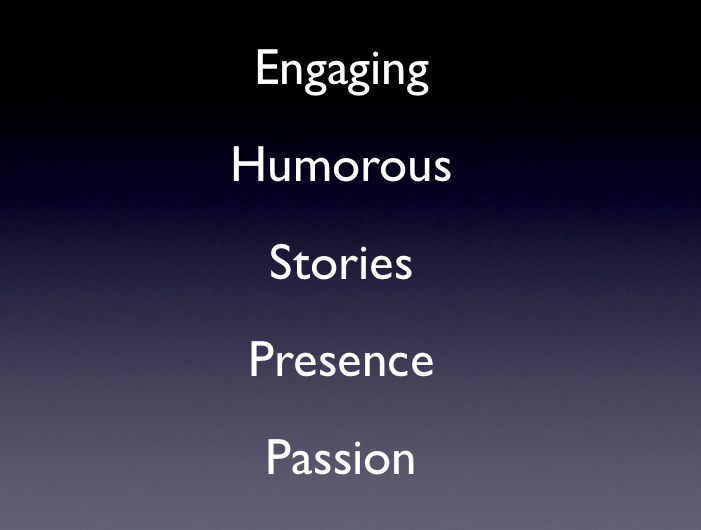
2. What’s in that bag of tricks? Here is one of my slides where I describe such “tricks”, actually qualities of the presenter:

So, the more you expect a gulf between you and your audience the more you need to especially focus on bringing these qualities to bear. Those will little prior or deep knowledge will not become rocket scientists at the end of your presentation. But they will remember your qualities as a presenter, your ability to bring to them an understanding of complex ideas in a way that does not belittle their limited knowledge base, but instead respects them because you’ve gone the extra distance by helping them understand and enjoy.

One of my favourite TED talks ever was the first I saw of Barry Schwartz, a social psychologist discussing his book, “The Paradox of Choice”. You can view his TEDtalk below (and then come back if you wish).

While his Powerpoint slides needed much working over (and they subsequently were for a second TED appearance here), the bulk of his talk was illustrated using New Yorker cartoons. Scientists using such humorous appliances with lay audiences I’ve found goes over very well, as long as they butt of the humour is not the audience’s own characteristics (e.g. a talk on lap band surgery to prospective customers which makes fun of their girth challenges).

3. Stories and in particular metaphors are particularly important and useful in conveying complex ideas to groups who do not possess fundemental knowledge of the subject. Each culture, creed and religion has its own stories it tells its generations, from Aesop’s fables through to the Digital Age’s LOST television series (sadly concluded, but satisfyingly so), as well as religious parables. Even science has its stories to tell, from Galileo’s pursuit of testable facts in the face of religious persecution, through the image of the scientist beavering away in pursuit of a “Eureka” moment, when in fact thr truer story is one of a team working together over years to make world changing discoveries, such as Howard Florey and his team’s work with penicillin.

All useful stories help lead us along a pathway to discovery, along the way perhaps mystifying and surprising us, creating tension then resolution. Great science presenters, if presenting to a low prior knowledge audience, will more rely on placing their scientific evidence or discoveries in the form of a story of discovery rather than a vanilla, “here are the facts”. They know that low level audiences don’t know what to make of those facts, while experts can more readily “join the dots” and see how new discoveries not just add to their personal knowledge, but to the field’s accumulated knowledge. They may question methodology or statistical inferences, something low level audiences will not be aware of, but their questioning is centred on issues of data veracity, such that conclusions reached can be considered reliable.

4. One of the other ways, besides storytelling, for science presenters to convey their messages to those with low levels of knowledge (but whose decision making may be crucial to their future scientific endeavours) is the principle of scaffolding.

Bamboo Scaffolding

I remember my first visit to Hong Kong before it was handed over to the Chinese in 1997, where I saw modern high rise constructions with bamboo used as scaffolding, an unusual (for me) mix of the very old with the very new.

As the building grew skywards, the scaffolding would accompany its journey building upon itself.

This is the essence of the metaphor of scaffolding when used in conveying complex ideas to low level audiences. While high level audiences might be given a complex idea directly in a slide, perhaps using an acronym known well by one’s peers, low level audiences must be led through a series of building blocks or “chunks” of information which minimally stretches their knowledge base. From there, more pieces are added in a logical sequence so that the audience is now in possession of a large chunk composed of many smaller chunks, all held together by the presenter’s style of presenting, using spoken words which match any words on the slide, as well as illustrations such as graphics, charts, pictures and diagrams which give picture to the words, and thus appeal to multiple senses.

Often, the building blocks or scaffolds are elements familiar to low level audience, but perhaps not understood in the context the presenters is using. By using pictures and words in appropriate sequences, the audience themselves do the work of putting the ideas and theories of the presenter together, an “uh-huh” moment when they “get it.” So while bamboo may have its agricultural purposes, it can be put to an alternative use to support the construction of large buildings.

Bright audiences attending lectures or presentations in fields other than their own, such as at an international congress or where multiple professions might attend, do well with scaffolding approaches to new learning, as they are so used to their own methods of “joining the dots” as it usually occurs in professions with a body of deep foundational knowledge.

Let’s go the other way for a moment and deal with scientific presentations to peers, where both presenter and audience are likely to share the same depth of foundational knowledge.

In this case, all of these positive features I showed in the slide that lists “engaging… humorous…” etc., can actually be negatives. Scientists like to see themselves as dispassionate, objective, methodic, and curious. Expressions of passion about their research in presentations to peers I’ve observed to be interpreted as “over-invested, emotional, blinkered, and untempered”; not a good thing.

Because they share profound foundational knowledge, peers presenting to each other skip many of the scaffolding and storey telling elements, populating their (usually) Powerpoint slides with busy graphs, bullet points, and the occasional cute animated graphic. The problem is taking these same slides and bringing them to an audience that might be bright but doesn’t possess the same profound knowledge.

Especially when it comes to charts and graphs (I set aside a whole session during Presentation Magic to discuss these elements), science presenters often fall short of the wonderful value these data illustrations can bring to the discussion arena. They too often badly label axes as in the illustration below which asks so much of the audience:

In this slide, notice how the Y-axis is labelled, and see how much work you have to do to decode it – actually just to read it! Why put so many words at right angles to how we normally read? The way it’s usually explained to me is that we read up the Y-axis from the (0,0) postion (where the X and Y axis are each equal to zero). But if that were the reason, why wouldn’t the number then read this way too, instead of being position horizontally like those for the X-axis? It simply means re-arranging the graph layout, but entrenched is this way of constructing graphs that despite the difficulty factor, scientists adhere to this supposedly scientific way of representing data. I think it’s nonsense, and doesn’t conform to what we know about how humans understand complex material.

In part 3 of this minor treatise on scientific presentation skills, I’ll offer some more hints and examples of how to give splendid scientific presentations to a variety of audiences.

Using Keynote to train scientists to present: Part 1 – knowing your audience

Last October I had the opportunity to lead a full-day Presentation Magic workshop for my psychology peers at my professional society’s annual conference in Darwin.

I had submitted it as a proposal for several consecutive years, and finally someone decided to take a chance on both the subject matter and me. I have presented workshops for the conference in the past (but not presentation skills), as well as local workshops for state sections.

The workshop attracted a diversity of academic and professional psychologists. I knew this beforehand because I asked the conference science committee to send me the class list. Fortunately, I was sent an Excel spreadsheet which included attendees names and their institute, including if they were in independent solo practice.

There are several things you could do with this data set which numbered 25 attendees, the top limit I had imposed.

Making Assumptions

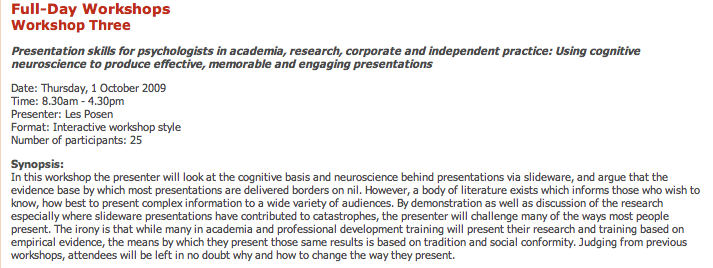
I made the early assumption that I would attracted a diversity of attendees, partly based on the writeup I had submitted to interest potential audience members which actually described the diversity I was aiming to assist. Here’s what it looked like on the website:

So let me go through some of the assumptions and actions that follow which I made in preparing for this challenging workshop. I say challenging because most attendees at Presentation Magic workshops aren’t up on the psychological aspects I bring to them, while I expect psychologists will… which means some of the element of surprise and delight may be underwhelming to this audience. Add to this dimension that I’m likely to know some of the attendees personally, and likely to bump into them again at future functions. No “hit and run” possibilities if you do a poor job!

So where to start in preparing? Well, I have a syllabus from previous Presentation Magic workshops and seminars, delivered to a variety of audiences, and continually tweaked via a feedback loop each time I present. The question is one of focus, emphasis and de-emphasis, second-guessing what the audience will want to experience given the write-up that attracted them in the first place.

My other preparation starting point was an assumption that psychologists’ presentations would be the usual Powerpoint stuff, even if they had bought a new Mac and were using Keynote. This is the voice of experience in your head, having been to my fair share of psychologists presenting. So I felt safe that my information and presentation style would engage the audience. The task was to refine the focus for this particular group.

I started by Googling the names of all the attendees, placing their names in Safari’s Google search window, but adding .ppt.  This allowed me to quickly locate any presentations attendees had offered in the public domain. The chances of a private practitioner being located this way are small, while it increases for academic psychologists. I located a few presentations by professors who were attending, as well as recent post-docs who had been doing the rounds of local conferences displaying their work.

What did turn up was interesting once I removed the ppt keyword and just searched on names: a mix of results that told me that some of my attendees were actually presenting at the same conference after my workshop; and the nature of the work they were performing in their employment.

The first part – that some were presenting – gave sense of immediacy to my upcoming workshop. Would it be possible to offer guidance some of the audience could use immediately, or would they lose confidence because their presentation slides contained many faults I was going to highlight (the usual suspects: too many words per slide, lousy clip art, poor colour choice, overused backgrounds, cliched animations, etc)?

But one must bear in mind another assumption that follows: that those people already up for a presentation and are willing to take time from the conference to attend a presentation workshop are sufficiently insightful to know they need assistance, that there is a better way – but what? So, rather than being concerned about the situation, I decided to take advantage of it. My thought was to side with them and offer that most people present the same way, and it’s not their fault.

If the cognitive style of Powerpoint is what powers most presentations, it takes a lot of confidence to go against the grain. This reinforced my desire to discuss early in the day the concept of “social conformity”, familiar to my audience, and how it can even impact on how psychologists present. I made the assumption that something they learnt about in Psychology 203 but applied directly to them so much later in their professional lives, and in ways they hadn’t thought of, would surprise and delight them. It would also offer me up as someone who “knew his stuff “as a professional psychologist and add to my authority status.

If they could experience surprise and delight on several occasions throughout the workshop, then perhaps they would appreciate its importance when it came to constructing their own presentations, even if the subject did not immediately lend itself to these concepts. But “surprise and delight” is what I want audience members to experience, because I assume it assists the likelihood my messages will be remembered, and my workshop too will be remembered as one to tell colleagues about, and score well in evaluations.

More assumptions about the audience

By looking at who was attending and where they worked, I made further assumptions. I began to make assumptions as to who my audience’s audiences were! In other words, to whom would they apply what they had learnt from me? Would it be inhouse training, presenting to politicians, pitching for tenders, training juniors, working directly with patients and clients, lecturing to students, developing e-learning tools, etc.

Of course, if you’re commissioned to develop a workshop you will spend considerable time with your contact drilling down on the audience’s composition, and your contact’s hopes for the workshop. (After all, long after you’ve left the scene, his or her work colleagues will remind him or her of what a great or lousy job he or she performed by contracting your services). Consultants develop this skill so as to properly target their audience, again with their intention of delighting them, while they gain an education they can immediately apply. That’s one of my personal mission statements.

Probably because so much of my early training in clinical psychology was learning to be part of a therapy team which focussed heavily on the intake process, that training has stayed with me beyond my work as a psychologist. Let me expand a moment, because it also explains why I personally take calls from patients wishing to make a first appointment. It surprises and delights them that they speak directly with me, rather than a secretary or PA. Those who feel it takes away from my professional status are best to seek help elsewhere – it’s a poor match from the get-go.

Part of the intake process is not to ask “what’s wrong”, but to work out if the caller’s desires are ones you can satisfy. This may have to do with what they wish to change (the biggest and most important assumption); how they see the change occurring and the role they expect you to play; how long they expect the process will take; what attempts have been made in the past (with or without professional help); who else is involved in their current concern and would it be appropriate for them to attend too; are there legal issues involved (will I sooner or later be asked to give evidence in court); how did they learn about me (being careful not to acknowledge the names of any patients who provided your name to their friends or family members); and of course, who’s paying and when do you expect to start?

Some professionals keep an intake checklist they go through to cover all basis, while others prefer a more conversational style which doesn’t sound like they’re ticking boxes and patients are just another number. I believe a good intake interview is worth a couple of face to face sessions, and can save the psychologist and the patient a lot of trouble down the track.

I mention all this because those of you who wish to go beyond the mechanics of slide construction no matter your creative tool of choice may also find yourselves in the role of consultant, employing your skills as I do helping others, as well as creating training materials leveraging your presentation skills, e.g., web-based learning, curriculum design, etc.

Returning to my audience for the October workshop, not only did it help me with my material preparation to know more about them, but I greeted each attendee as they arrived by name. I had printed out first name tags before I left for Darwin (using a Dymo Labelwriter 400 and folded-over 3 x 5 cards), and asked each attendee to place it in front of them when they were seated. When they picked up the label from the front table on entry to the room, I greeted them personally and using memory said something like, “Oh, Anne, you’re in private practice in Adelaide” or “Michael, you work with the Smith Agency in Sydney… what sort of work are you doing there?”

With much larger audiences where all this research is not feasible, I arrive early at the venue, make sure the technology including my own is working (I actually run through as many slides as possible to double-check), then walk around the group saying hello and generally “working the room” before we make a start. The higher up you get in the public speaking sphere, the more presenters want their entry on stage to be a big deal, so getting to know the audience just doesn’t happen. I learnt this going to television shows where a warm-up artist would get the audience in a good mood, let them know their role in the television recording (when to cheer, applaud, be quiet, etc) and then the main host would enter to huge applause. Occasionally, some hosts would come out early and warm up the audience themselves, especially if there was to be audience involvement as part of the show.

These first few moments before you start can be critical, literally setting the stage, and giving you a chance to reach out to the audience way before you show your first slide. Don’t ever underestimate its importance in getting you over, and helping settle any apprehensions you may have. In my October session I located a few professors to whom I would direct questions later, a Jungian analyst to whom I would sidle up and openly discuss archetypal stories, and a psychiatrist who was feeling like a fish out of water but had come especially for the workshop, deeming it an important aspect of his professional development. Later in the workshop I was able to utilise his unique (for this audience) knowledge base. Again, knowing what he might know from his psychiatry training added to my authority.

Assumptions and risk taking

Making assumptions always carries risks of being wrong. Good presenters I believe do their audience research, construct their presentations with a knowledge base in mind, then act on that knowledge base ever mindful of how they’re getting their message across. They have stories to tell, ideas to share, and good antennae for knowing how they’re doing.

In Ocotober, I decided to throw caution to the wind, not sure if I’d ever be invited back, and try some new ideas for the first time. It wasn’t as risky as you might first think, because I decided to co-opt, then augment some ideas from my mate Garr Reynolds and his mate, Nancy Duarte. Just a few days before I left for Darwin, Nancy had blogged, with video, some time she’d spent with Garr in conversation about scientific presentations. I liked the ideas discussed, and so at some early point in my workshop, having made some assumptions about the audience, I employed their ideas. It was based on the diversity of audience members whom I assumed wanted something a little different because of their audiences.

What I used from Garr and Nancy

Below is the video from Nancy’s website which I decided to use as a starting point where they discuss the concept of the Presentation Landscape:

And here is the associated diagram Nancy produced on her website to highlight this two dimensional diagram:

Let me sum up by writing that what Nancy is saying is a useful heuristic when considering your audience and matching your presentation to their perceived need:

You can consider your presentation as existing on two orthogonal axes. One, the horizontal in Nancy’s landscape diagram represents the structure or sophistication of the presentation. At one end, the presentation in fact is merely a handed-out document of the slides – a slideument to use Garr’s expression – which is merely a Word diagram imported into Powerpoint and made to look like a Powerpoint slide. This might be the pdfs of slides students download before they attend a lecture. There’s room to annotate it as the lecture proceeds. At the other extreme is the full-on presentation delivered with all the whistles and bells modern multimedia can offer up.

The vertical axis is a measure of what the presenter brings to the audience, and so also includes audience characteristics. At one extreme is an informal presentation, perhaps to one’s colleagues over a lunchtime meeting; at the other, is one where to use Nancy’s terms, you put on your “Game Face”, where your presentation really counts, where you pull out all your presenter training and gifts. Lots hangs on this presentation.

Notice in the Presentation Landscape that the most populous quadrant suggested by Nancy is the one that more combines formal with presentation, which one presumes is where much of Nancy’s experience (and income) resides. The least is the full-on presentation in an informal domain. This is where I spend a lot of my clinical time, showing patients complex information about their disorders and concerns and using Keynote to break down these ideas into manageable chunks, letting the slides tell a story. From time to time, I also use Keynote to illustrate fearful situations or objects especially for those who have a severe phobia, and this forms part of an exposure-based program, a gold standard for phobia treatment.

In Darwin, I used this structure as a starting point, and gave my audience a chance to break into small groups of five and describe to their colleagues how this  2 x 2 matrix fitted for them. Now, since these were new ideas about presenting, I wanted to offer the group a way to visualise their task, so I offered up some illustrations of the four elements of the matrix (I didn’t show them the Garr/Nancy video, but preferred to use psychology based examples to aid the learning process).

Here’s what I showed them, with my recorded narration (and I used the same slides at Macworld this year too):

Now the Landscape model is a reasonable one, and easy to teach in a presentation class. But I fear it is missing a third, and extremely important dimension, one that comes from the neuroscience of learning: the dimension of Prior Knowledge.

How Garr and Nancy’s Presentation Landscape model is missing this vital piece will be covered in Part 2 of this entry, next.

In the Gizmodo/iPhone prototype story, the journalism shield law is the side salad; the main meal is the revelation of trade secrets and how they were obtained

What do these names mean to you?

Chana, Dongfeng, Zotye, Gonow, Roewe, Hawtai, Lifan, Chery, Geely and BYD

Not much perhaps…

But if you’re on the Boards of Ford, Chrysler, General Motors or Honda, all of whom manufacture motor vehicles in the USA, you know these names very well, and they worry you.

You see, they are all Chinese auto manufacturers preparing to export their vehicles to the West and give local brands a run for their money. Geely, for instance, now owns Volvo. BYD is one of the largest auto manufacturers in the world. And already on local Aussie television, I am seeing advertisements for Great Wall Motors 4WD, passenger and utilitarian vehicles (see advertisement below). These are often two-thirds of the price of local vehicles, but if they come with a three year warranty at the same price as a used well-known vehicle…

GM, which required US tax payers money to bail it out, has opened a major factory in China in an effort to reverse the import drain and find a profitable presence in the Chinese economic powerhouse.

Western companies face a major dilemma when it comes to competing with the Chinese. They manufacture there in order to keep costs down, and it’s likely that the computer you’re using to read this blog may have been designed in the US, but it will have been manufactured in China. The Chinese, like the Japanese before them, are becoming master emulators, reverse engineering US designed goods to a quite high specification.

China is already building its own commercial passenger jets, having been a major Boeing and Airbus purchaser for a decade now, with a huge and growing internal marketplace for civil aviation. It’s using home-grown R and D, plus the purchase of American know-how from household names, like GE. For years, Chinese companies have manufactured elements of Boeing 737s, and are also involved in the new materials 787, currently being tested for certification for first deliveries next year.

And therein lies the dilemma: Use cheap Chinese labour to maintain profitability in the short term while waiting for the Chinese to develop their own products to compete with the West in the long term. And guess how the Chinese will develop the knowledge to become competitors for American products? From their building American products for American corporations plus their own home-grown R and D plus the purchase of American know-how.

If the US has one great advantage over the cheap labour of the East, it’s the ability to innovate, to stay an intellectual step ahead of its competition.

Companies like Apple, which design both the software and hardware for its products, show what happens when you control the whole widget because as its increasing sales quarter after quarter shows, it’s a very hard act to emulate. But to maintain that level of emulation difficulty requires secrecy and strategising over a number of years of a product’s being brought to market. It’s part of Apple’s DNA, given how the emulation of its core OS features that made a Mac a Mac was “emulated” by Microsoft after Steve Jobs gave Bill Gates a Mac for software development.

So when Apple’s intellectual property is made visible to the world not as the finished product for sale, but in an effort to scoop other web-based publications which could allow competitors several months head start to ramp up their copying, Apple no doubt sees it as a threat to its ability to conduct business its way. We’re not talking about some pissant backwater low-tech company, but a major US corporation which has been a financial powerhouse in recent years of overall poor US financial performance amidst questionable ethical behaviour by leading corporations.

If some disaffected employee, recently fired from Apple, had decided to visit Gizmodo and spill his guts in breach of his NDA, and Gizmodo had decided to publish that information, that’s one thing, which may have its own legal consequences for both parties to the publication.

But in the iPhone case, we’re not just talking about a seemingly nice young man who probably should have done more to return the iPhone to its owner (the guy who brought it into the bar), according to his own lawyer in a statement that one tends to hear after a guilty plea has been entered in order to mitigate a sentence (I mean, the 21 year old who found it has not been charged yet and his lawyer is almost rolling over with pleas for clemency). We appear to be talking about hawking about the place, property of a sensitive nature to the highest bidder once its uniqueness became known, and an effort was made to place a value on that uniqueness. The iPhone prototype is not unique; there are probably dozens of them in Apple employee hands doing exactly what Gray Powell was doing: roadtesting in the wild according to the usual pre-production plans and strategies (although after this security breach, Apple may have gone to Plan B for its road testing). What made his iPhone unique was it was the first device which found its way into the hands and onto the pages of a technology-based website without Apple’s consent.

That it found its way there through dubious, and likely illegal means (the latter of which will shortly be tested), is but one part of the story as is the reports of  “breaches” of California shield laws in the seizure of Jason Chen’s computer equipment which has the journalism world spending much time navel gazing. But from this distance, it’s the exposure of trade secrets which I believe is uppermost in Apple’s corporate mind, and will eventually see a civil suit brought against Gizmodo, with the criminal law enforcement officials looking at the issues surrounding the iPhone’s non-return in the first place, including Jason Chen’s and Gawker Media’s involvement.

Consider this: What if the finder and his associates in their hawking the iPhone had turned it over to someone purporting to be a mainstream website, but who in the exchange of money for the iPhone turned out to be the representative of a far-east manufacturing facility with the means to quickly reverse engineer and begin the manufacture of thousands of such phones, which could take Apple months if not years to halt production and selling through legal avenues? Not in the US where of course it could bring an order for their immediate non-importation. I’m talking of the Asian and sub-Asian continent where billions of dollars of counterfeit US-designed products have already flooded the market.

So, yes, let’s have a little fun at Apple’s expense via The Daily Show (who as funny as it may have been in asking Steve Jobs for some personal time on Camera 3), but let’s not obscure through mirth and omission of salient facts the seriousness of what’s occurred. While journalists, pseudo-journalists and lawyers can blather on about the protection of rights, such as who is a journalist as in this meandering “think piece”, there is a bigger question at stake about the levels of protection against the plundering of intellectual property US citizens are willing to tolerate.

Let me put what’s happened another way, similar to the car analogy in my previous blog entry, which seemed somewhat convincing to many readers.

The son of a very senior industrial chemist who happens to work in Atlanta for Coca-Cola quickly needs to make a copy of last night’s Daily Show with Jon Stewart to give to a friend he’s meeting in a downtown bar. He enters his father’s study, and removes a USB thumbdrive from his father’s draw, where he knows quite a few are kept, complete with Coke logo. He takes it back to his PC, copies the video file, and tells his friend to meet him where he’ll give him the USB drive.

They meet, the USB drive is handed over with the promise it will be returned next time they meet. The friend later lends the same drive to another friend with the Daily Show and now a copy of this week’s Lost on it, and the friend who happens to be studying chemistry at Berkley discovers on the USB a text file with a chemical formula. He figures it’s the formula for a possible new version of Coke. (Silly Coke chemist for having such vital data sitting in his study drawer). What should the person do? What would you do?

Do you take the story to the New York Times, and ask for $5000 to send them the stick, having perhaps sent them some of the formula for them to have it verified by experts? Do you ring up Coca-Cola? Do you retrace the USB stick’s chain of ownership, perhaps more likely if you’ve been following the Gizmodo situation. Do you wipe the stick? Do you publish it on Facebook? Do you perhaps take it to Pepsi? Or do you locate a cola manufacturer in a foreign country and begin negotiations, knowing that millions of dollars are at stake, and thousands of US jobs?

I mean, it’s Coke after all. They don’t make defibrillators, anti-depressant medication, commercial jets, or anything truly meaningful other than sugar water, if you’ll pardon the historical pun. What community harm can be done?

Enough with the rhetoric. The more this situation goes on without Jason Chen/Gizmodo either being charged, subpoenaed or having his equipment returned, the more it turns into the old familiar Apple fan versus Apple hater soap opera, with a side-dish of who’s a journalist and what rights do they have, and the true potential harm is obscured. And perhaps that’s something Apple is happy to do, until they reveal it on their own terms in a civil action.

UPDATE: As I was composing this blog entry, a US friend sent me a media release from the United States Attorney’s Office for the central district of California regarding a matter where a UCLA medical researcher, having been terminated, looked into the medical records of his supervisor’s patients, including some well-known celebrities, in breach of the HIPAA. Below is part of the media release, important because this is the first instance of incarceration for a breach of the privacy provisions of HIPAA – ie., just for looking, not even on-selling to the media.

Moral of the story: Some things are simply meant to be taken seriously, even where there appears on the surface to be no victim or harm done, if you choose to look at it that way. Which is the wrong way, as it turns out:

A former UCLA Healthcare System employee who admitted to illegally reading private and confidential medical records, mostly from
celebrities and other high-profile patients, was sentenced to four months in federal prison.

Huping Zhou, 47, of Los Angeles, was sentenced by United States Magistrate Judge Andrew J. Wistrich, who condemned Zhou for his lack of
respect for patient privacy.

Zhou pleaded guilty in January to four misdemeanor counts of violating the federal privacy provisions of the Health Insurance Portability and
Accountability Act (HIPAA).

Zhou specifically admitted to knowingly obtaining individually identifiable health information without a valid reason, medical or otherwise.

Zhou is the first person in the nation to be convicted and incarcerated for misdemeanor HIPAA offenses for merely accessing confidential records
without a valid reason or authorization.

Zhou, who is a licensed cardiothoracic surgeon in China, was employed in 2003 at UCLA Healthcare System as a researcher with the UCLA School of
Medicine.

On October 29, 2003, Zhou received a notice of intent to dismiss him from UCLA Healthcare for job performance reasons unrelated to his
illegal access of medical records.

That night, Zhou, without any legal or medical reason, accessed and read his immediate supervisor’s medical records and those of other co-workers.

For the next three weeks, Zhou’s continued his illegal accessing of patient records and expanded his illegal conduct to include confidential
health records belonging to various celebrities.

UPDATE: MAY 3 – Lawyer and blogger Peter Scheer, who is also Executive Director of the First Amendment Coalition, has a well-reasoned article in this weekend’s Huffington Post, entitled “Strip-searched: Lost iPhone probe shows why search warrants should never be used on journalists”.

It puts the California Shield laws at the centre of this story, whereas I see it as almost a red herring. But as a non-US citizen, I am not as steeped in First Amendment lore (and law) as someone like Scheer. Do read his article; it’s well written. (Although when you get to the section on how a person’s life would be turned upside down if their servers would be removed you’d wonder about issues of backing up essential items for work continuity. And you’d also wonder if perhaps secret information sources might be just a tad perturbed by the actions of Gizmodo and Jason Chen prior to the seizure warrant being issued, such as when they went very public with their iPhone story. If it was me, I would have mailed them to destroy all email correspondence because I considered a raid was imminent.)